
GASTROINTESTINAL PROCEDURE FRISCO / PLANO, TX
Hemorrhoid Banding in Frisco/Plano, TX
Chronic cases of hemorrhoid bleeding or prolapsed tissue may continue despite lifestyle changes, dietary modifications, and the use of medications. One remedy for the condition is Hemorrhoid Banding in Frisco/Plano, TX. Hemorrhoid Banding is an office-based treatment for certain internal hemorrhoids that involves the placement of rubber bands on the rectal hemorrhoids, thereby blocking blood circulation to the tissue, allowing the tissue to shrink and separate.
Barrett’s Esophagus Expertise
Upper Endoscopy On-Site
Board-Certified GI
However, it’s important to know the right patients for this procedure. A gastroenterologist or GI doctor for hemorrhoids needs to look at the location, size, bowel habits of the patient, and his/her past medical history before deciding on whether to treat him/her with banding. According to ASCRS (American Society of Colon and Rectal Surgeons) guidelines, this procedure is suited for mostly grade I and grade II hemorrhoids, and selected grade III hemorrhoids.
Hemorrhoid Banding in Frisco/Plano, TX for Internal Hemorrhoid Symptoms
Internal hemorrhoids consist of swollen blood vessels that lie within the anal canal and often result in painless bleeding during bowel movements. Patients with Hemorrhoids in Frisco/Plano, TX may notice bright-red bleeding, prolapsing tissue, pressure, or other symptoms that require a GI evaluation before treatment is selected.
In cases where this condition becomes even worse, the hemorrhoids can prolapse, resulting in lumps outside the anus, which need to be treated manually. If the conservative approaches including enough fluid intake, fiber, and improvements in bowel habits, don’t solve the problem, it may be the right time for someone suffering from either chronic grade I or II hemorrhoids or grade III hemorrhoids that are not very complicated to consider the banding technique for treatment.
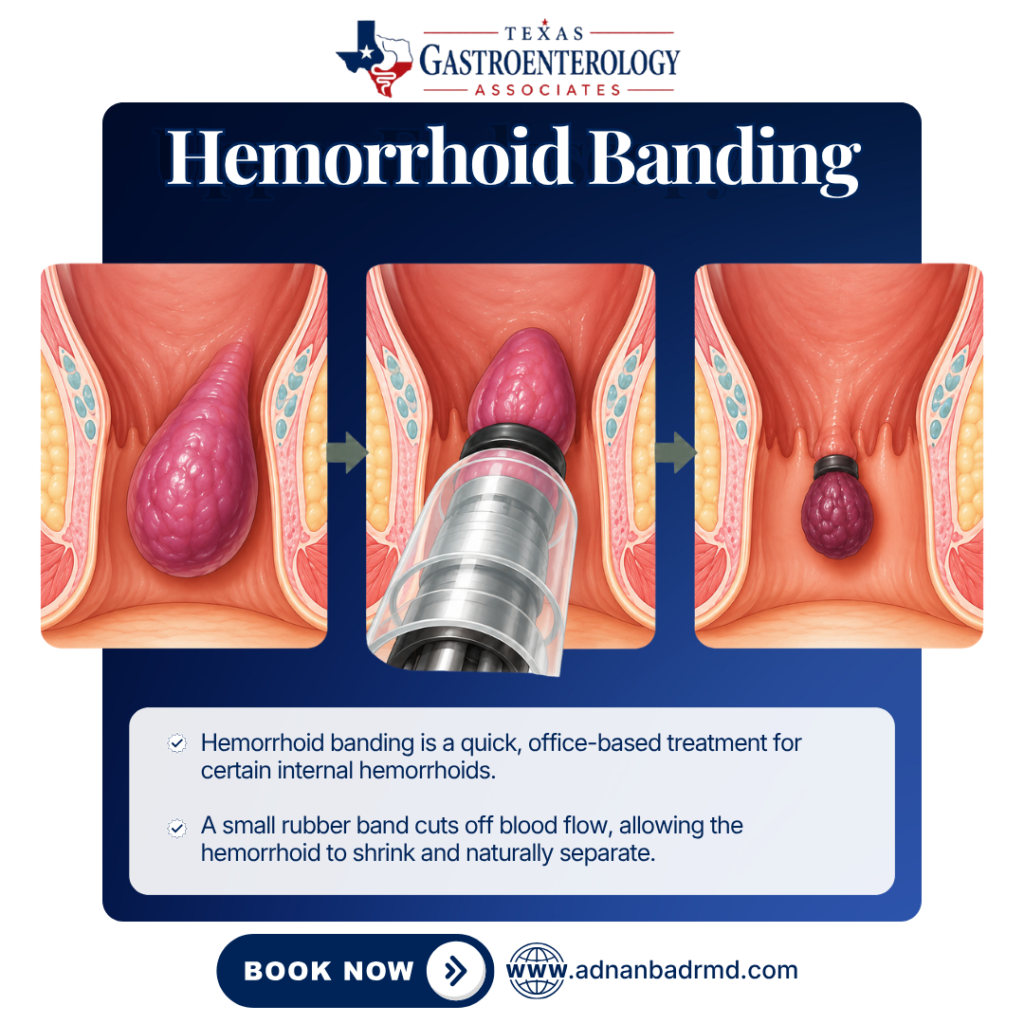
Before the banding procedure, the gastroenterologist must analyze the level of blood loss, the extent of prolapse, the patient’s bowel habits, the medications being taken, and medical history to make sure that the symptoms are truly due to hemorrhoids. This requirement is because the banding technique only treats the swollen tissues and doesn’t eliminate the causes of blood loss related to anal fissure, polyp, inflammatory bowel disease, or any gastrointestinal diseases.
Bleeding Hemorrhoids and Prolapsing Tissue: When Banding May Be Considered
Bleeding hemorrhoids usually produce bright-red blood when a person has bowel movements, while prolapsing hemorrhoids may produce tissue protruding from the anus. Banding closes off the blood supply, so it can help stop bleeding and some types of prolapse from happening.
Not every prolapsing hemorrhoid will qualify for banding treatment. The degree of protrusion of tissue from the anus and whether it returns naturally may play a role in determining the treatment of choice. This is why an evaluation should be part of a hemorrhoid treatment in Frisco/Plano, TX, rather than relying on symptoms alone.
Internal Hemorrhoids vs External Hemorrhoids: Why Banding Is Not for Every Type
Internal hemorrhoids originate in the rectum, whereas external hemorrhoids originate in the sensitive skin around the anus. Rubber band ligation is a method of treatment that applies to internal hemorrhoids and not to external hemorrhoids.
The reason this distinction is significant is that external hemorrhoids may cause painful lumps, especially when thrombosed. A patient may have both an external and internal condition at the same time, in which the internal hemorrhoid, being present, causes bleeding, while the external hemorrhoid causes discomfort.
Rectal Bleeding Evaluation Before Assuming It Is Hemorrhoids
Apart from hemorrhoids, some conditions that can also cause bleeding include anal fissures, polyps, diverticular disease, colorectal cancer, and inflammatory bowel disease.
Because symptoms of Hemorrhoids in Frisco/Plano, TX, can overlap with other causes of rectal bleeding, the source of the bleeding should be evaluated before assuming hemorrhoids are responsible.
Before concluding that hemorrhoids are the cause of rectal bleeding, a GI doctor for hemorrhoids in Frisco/Plano, TX, should conduct a thorough rectal bleeding evaluation.
When looking into whether a patient has hemorrhoids, a gastroenterologist considers various factors like the patient’s age, bowel changes, family history, colorectal screening history, and bleeding patterns before advising on an appropriate course of action such as an examination or colonoscopy in Frisco/Plano, TX.
When Creams, Fiber, and Sitz Baths Are No Longer Enough
Eating fiber, adequate hydration, using creams, taking Sitz baths, and avoiding strain while passing solid stools, as well as reducing time spent sitting on the toilet, will help provide an initial relief. These measures may relieve hemorrhoidal tissue from excessive pressure but cannot stop recurrent bleeding or prolapse.
Hemorrhoid Banding in Frisco/Plano, TX, may become an option when conservative care no longer controls recurrent bleeding or prolapsing internal hemorrhoids.
With persistent complaints, one may need to resort to non-surgical hemorrhoid treatment such as banding. It’s still essential to treat constipation or diarrhea, since bowel patterns causing hemorrhoids may provoke recurrence.
Rubber Band Ligation: How Non-Surgical Hemorrhoid Treatment Works
In the rubber band ligation process, the physician will loop a rubber band around the internal hemorrhoids, just above the dentate line, which will halt all blood flow and allow the hemorrhoidal tissue to eventually separate while scar tissue forms during healing.
Since there’s no surgical incision involved in the process, recovery is usually much simpler compared to hemorrhoidectomy. However, certain medications like anticoagulants and antiplatelets that can hinder the healing process and possibly increase the chances of bleeding should be discussed with the physician before the operation.
Does Hemorrhoid Banding Hurt? What Patients Usually Want to Know
After undergoing banding treatment, patients might experience a pressure/fullness sensation, mild cramping, and the urge to defecate. Proper placement above the dentate line will prevent pain because this area is less sensitive compared to the skin of the external anal area.
Severe and worsening pain is different from normal pressure and should be reported. Recovery also depends on how many hemorrhoids are treated and the patient’s previous bowel conditions.
Recovery After Hemorrhoid Banding: Work, Bowel Movements, and Normal Activity
Recovery after Hemorrhoid Banding in Frisco/Plano, TX, is generally shorter than recovery after traditional hemorrhoid surgery because no surgical incision is required.
Non-surgical hemorrhoid treatment in Frisco/Plano, TX, has the advantage of having a quicker recovery time when compared to conventional surgery. Most patients can resume their daily routines almost immediately, while there might be some discomfort.
It’s usually not advisable to avoid bowel movements; keeping stools soft and avoiding straining helps protect the healing area. While some bleeding is to be expected, heavy bleeding, severe pain, fever, or fainting need urgent medical attention.
Why Hemorrhoid Banding in Frisco/Plano, TX May Require More Than One Session
There may be multiple hemorrhoidal areas causing issues, so treating one hemorrhoid might not eliminate every source of bleeding or prolapse. The ASCRS notes that patients may occasionally require multiple banding procedures in order to resolve hemorrhoids completely.
A second procedure might not indicate that the first was unsuccessful. Follow-up after surgery allows the doctor to figure out if another hemorrhoid exists or whether the cause of the symptoms is unrelated to hemorrhoids.
When Hemorrhoid Banding Is Not the Right Treatment Option
Large external hemorrhoids, large external disease, and advanced prolapse may require other treatment options, including the possibility of surgery for certain grade III and grade IV conditions.
Unexplained bleeding is another reason to investigate before resorting to banding. It’s always prudent to determine the source of the symptoms before selecting treatment. Consulting aexpert like Dr. Adnan S. Badr is key for success.
Hemorrhoid Banding With Dr. Adnan S. Badr in Frisco/Plano, TX
Dr. Adnan S. Badr is a board-certified, multiple award-winning gastroenterologist who has been providing his services in the regions of Frisco and North Texas since 1999. He performs expert hemorrhoid banding along with various other gastroenterology services such as colonoscopy, colorectal cancer screening, upper GI endoscopy, and many more. This broader GI focus is very helpful in identifying the causes of rectal bleeding, as it needs to be investigated rather than just being presumed to be related to hemorrhoids.
If you’re facing severe internal hemorrhoids, bleeding, or tissue prolapse, Dr. Badr will evaluate your condition and advise if you need any further testing before starting Hemorrhoid Banding in Frisco/Plano, TX.
You can call him at (972) 514-3530.
Before Banding, Dr. Badr Confirms the Source of Bleeding
It is easy to assume that bright red blood must be coming from hemorrhoids, especially when bleeding occurs during a bowel movement. That is often the cause, but it should not be taken for granted.
Dr. Badr may ask about:
- When the bleeding started
- Whether the blood is bright red, dark, or mixed with stool
- Pain during or after bowel movements
- Constipation and straining
- Tissue that protrudes from the anus
- Changes in bowel habits
- Previous colonoscopy findings
- Personal or family history of colon polyps or colorectal cancer
- Blood thinners and other medications
Depending on your age, symptoms, screening history, and risk factors, additional evaluation may be recommended before treatment.
Not every patient with rectal bleeding needs a colonoscopy before banding. The goal is to make sure the symptoms fit internal hemorrhoids and that another important cause is not being overlooked.
Which Hemorrhoids Can Be Treated With Rubber Band Ligation?
Hemorrhoid banding is used for internal hemorrhoids.
Internal hemorrhoids develop inside the lower rectum. They may bleed, swell, or move downward during a bowel movement. Some return inside on their own, while others may need to be pushed back.
External hemorrhoids are different. They form beneath the skin around the anus and are not treated with internal rubber band ligation. A thrombosed external hemorrhoid, which contains a painful blood clot, also requires a different approach.
Banding may be considered when internal hemorrhoids cause:
- Recurrent bright red bleeding
- Prolapse during bowel movements
- Mucus or irritation
- Pressure or fullness
- Symptoms that continue despite changes in bowel habits and home care
Not every internal hemorrhoid is suitable for banding. Dr. Badr considers its position, size, degree of prolapse, and your medical history before recommending the procedure.
The right hemorrhoid treatment in Frisco/Plano, TX, depends on whether the problem is internal, external, thrombosed, prolapsing, or caused by another condition.
Bleeding, Prolapse, Pressure, or Pain
Internal hemorrhoids often cause bleeding without severe pain.
Common symptoms include blood on toilet paper, blood dripping into the toilet, or internal tissue that comes outward during a bowel movement. Some patients feel pressure, incomplete emptying, itching, or irritation.
Sharp or intense pain is less typical of uncomplicated internal hemorrhoids.
Severe pain may point toward:
- An anal fissure
- A thrombosed external hemorrhoid
- An abscess
- Significant inflammation
- Another anorectal condition
This distinction matters because hemorrhoid banding will not fix pain caused by a different problem.
Dr. Badr evaluates the full symptom pattern rather than choosing treatment based on bleeding alone.
How Hemorrhoid Banding Works
During rubber band ligation, a small band is placed around the base of the internal hemorrhoidal tissue.
The band restricts blood flow to the targeted tissue. Over time, the tissue shrinks and separates naturally. A small amount of scar tissue forms at the treatment site, which can help hold the remaining tissue in a more normal position.
The treated tissue does not disappear immediately during the appointment. The process happens over the following days.
Many patients do not notice when the band and treated tissue pass during a bowel movement.
The band must be placed above the most pain-sensitive area of the anal canal. Proper placement is one reason the procedure is generally associated more with pressure or fullness than sharp pain.
What Happens During the Hemorrhoid Banding Procedure?
The visit begins with a review of your symptoms, health history, medications, and previous treatment.
Dr. Badr may examine the anal and rectal area and use a small instrument called an anoscope to see the internal hemorrhoid.
Once the hemorrhoid is identified, a banding device is positioned and a small rubber band is released around the base of the tissue.
The treatment itself is generally brief, although the full visit includes evaluation, preparation, and aftercare instructions.
Hemorrhoid banding is usually performed without an external incision. Many office-based procedures do not require general anesthesia or a long recovery period.
The exact process, including whether a driver or special preparation is required, should be confirmed with Dr. Badr’s office before the appointment.
Will Hemorrhoid Banding Hurt?
It is more accurate to say that the level of discomfort varies than to describe banding as completely painless.
After treatment, patients may feel:
- Pressure in the rectum
- Fullness
- An urge to have a bowel movement
- Mild aching
- Temporary cramping or discomfort
These sensations may improve as the body adjusts to the band.
Sharp, severe, or increasing pain is not something you should simply wait out. It may mean the band is too close to a sensitive area or that another problem needs attention.
Contact Dr. Badr’s office if discomfort is stronger than expected or continues to worsen.
The goal is to set realistic expectations. Most patients do not need a surgical recovery, but that does not mean every person feels completely normal immediately after the procedure.
Why More Than One Banding Session May Be Needed
Some patients have more than one enlarged internal hemorrhoid.
Treating all affected areas during one visit may increase pressure, discomfort, or other risks. For this reason, treatment is often staged.
More than one session may be recommended when:
- Several internal hemorrhoids are present
- Hemorrhoids are located in different areas
- Prolapse is more advanced
- Bleeding improves but does not completely stop
- Treating less tissue at one time is considered safer
Needing another session does not mean the first treatment failed.
Dr. Badr bases the plan on the number of hemorrhoids, the severity of symptoms, and how you respond after each procedure.
Preparing for Hemorrhoid Banding in Frisco/Plano, TX
Hemorrhoid banding preparation is usually simpler than colonoscopy preparation, but medication and bowel instructions still need to be individualized.
Tell Dr. Badr if you take:
- Blood thinners
- Aspirin
- Anti-inflammatory medicines
- Diabetes medications
- Vitamins or supplements that may affect bleeding
Also mention any history of bleeding disorders, recent anorectal procedures, infection, immune-system concerns, pregnancy, or possible pregnancy.
Do not stop a prescribed blood thinner on your own.
The risk of bleeding must be balanced against the reason the medication was prescribed. Dr. Badr may need to coordinate with the clinician who manages that medication.
Depending on the office protocol, you may receive instructions about an enema, food, medication timing, or transportation.
Follow the instructions provided specifically for your appointment rather than using a preparation plan found online.
Hemorrhoid Banding Recovery, Bowel Movements, and Activity
Most patients can return to light daily activities without a long recovery. However, the exact timing depends on how you feel, your job, and the number of areas treated.
You may be advised to avoid:
- Heavy lifting
- Strenuous exercise
- Repeated straining
- Sitting on the toilet for long periods
Keeping bowel movements soft is an important part of recovery.
Dr. Badr may discuss fiber, fluids, stool-softening measures, or other changes based on your bowel habits and medical history.
You can still have a bowel movement after banding. The band is designed to remain on the targeted tissue while stool passes through the rectum.
If you feel pressure or the urge to go shortly after treatment, follow the office instructions. Do not force or strain.
Patients with physically demanding jobs may need different activity guidance than those with desk-based work.
Bleeding After Hemorrhoid Banding
A small amount of bleeding may occur after the procedure.
It may happen with a bowel movement or around the time the treated tissue separates. The amount and timing can vary.
Contact the office or seek urgent care according to your instructions if you develop:
- Heavy bleeding
- Bleeding that continues or increases
- Large blood clots
- Dizziness or fainting
- Unusual weakness
- Shortness of breath
Blood-thinning medication can affect bleeding risk, which is why medication planning is important before the procedure.
Do not assume that all post-procedure bleeding is normal. When the amount seems significant or is accompanied by weakness, dizziness, or other concerning symptoms, seek medical guidance promptly.
When Pain, Fever, or Urinary Problems Need Attention
Although hemorrhoid banding in Frisco/Plano, TX, is an outpatient treatment, complications can occur.
Contact Dr. Badr or seek urgent care for:
- Severe or increasing rectal pain
- Fever or chills
- Difficulty urinating
- Inability to urinate
- Significant swelling
- Persistent nausea or vomiting
- Heavy rectal bleeding
- Feeling faint or seriously unwell
These symptoms are different from mild pressure or temporary fullness.
Follow the written instructions you receive after the procedure, including who to call after office hours.
Banding Does Not Fix the Cause of Straining
Hemorrhoid banding treats the enlarged internal tissue, but it does not automatically correct the bowel habits that may have contributed to the problem.
Symptoms can return when ongoing pressure continues from:
- Chronic constipation
- Hard stool
- Frequent straining
- Long periods spent sitting on the toilet
- Repeated diarrhea
- Pelvic-floor problems
- Irregular bowel habits
Dr. Badr may recommend changes aimed at making bowel movements easier and reducing repeated pressure on the rectal veins.
Long-term treatment is not only about removing the current hemorrhoid. It also involves identifying why straining, constipation, or irritation keeps happening.
When Banding Is Not the Right Treatment
Another treatment may be more appropriate when symptoms come from:
- A thrombosed external hemorrhoid
- A large external hemorrhoid
- An anal fissure
- An abscess or infection
- Very advanced prolapse
- A non-hemorrhoidal source of rectal bleeding
- Severe pain from another condition
- Internal hemorrhoids that have not responded to banding
Treatment options may include continued conservative care, another office-based procedure, or referral to a colorectal surgeon.
Surgery is not required for every hemorrhoid, but banding is also not appropriate for every patient.
The right treatment depends on whether the problem is internal, external, prolapsing, painful, bleeding, or caused by something else.
How Long Do the Results Last?
Hemorrhoid banding may provide lasting improvement in bleeding and prolapse, but no treatment can guarantee that hemorrhoidal symptoms will never return.
New enlargement may develop later, especially when constipation, straining, prolonged toilet sitting, or frequent diarrhea continues.
Some patients need another banding session in the future.
The goal is durable symptom control, improved bowel habits, and a treatment plan that matches the severity of the condition—not a promise of permanent removal after one visit.
ANSWERS TO COMMON QUESTIONS
Frequently Asked Questions
Yes, if a particular bleeding originates from the internal hemorrhoid, it can be resolved by this method as the supply of blood to the affected hemorrhoid is cut off. However, if bleeding continues or is unexplained, a medical evaluation is recommended.
No, rubber band ligation is used exclusively for the treatment of internal hemorrhoids. External hemorrhoids require different management depending on their size, symptoms, and whether they are thrombosed.
Most of those who have undergone the procedure don’t even notice the moment the hemorrhoid separates. The tissue shrinks and separates in the process of healing, sometimes accompanied by minor bleeding.
Minor bleeding can happen during the process of separation of the treated tissue, while excess or continual bleeding is abnormal and requires medical attention.
Normally, there’s no reason to postpone a bowel movement. Preventing constipation and straining is more crucial for protecting the treated area.
Several hemorrhoids may be the reason for the problem, so one procedure is sometimes not enough. Follow-up helps to determine if an additional banding procedure is necessary.
If there’s excessive bleeding, acute pain, fever, fainting, or severe weakness, the patient needs to seek urgent medical help. Severe symptoms should not be considered part of the healing process.

Schedule a Hemorrhoid Banding in Frisco/Plano, TX
If you have recurring bright red bleeding, internal tissue that prolapses during bowel movements, or symptoms that have not improved with home care, Dr. Adnan S. Badr can evaluate the cause and determine whether hemorrhoid banding is appropriate.
Dr. Adnan Badr MD in Frisco/Plano, TX, is a board-certified gastroenterologist in Frisco/Plano, TX who evaluates rectal bleeding and determines whether office-based banding is appropriate.
Frisco
4500 Hillcrest Rd, Ste 185, Frisco, TX 75035
Plano
5800 Communications Parkway, Plano, TX 75093
Phone
(972) 514-3530 · Fax (972) 514-3531
Hours
Mon–Thu 8:00 AM–4:30 PM · Fri 8:00 AM–4:00 PM