
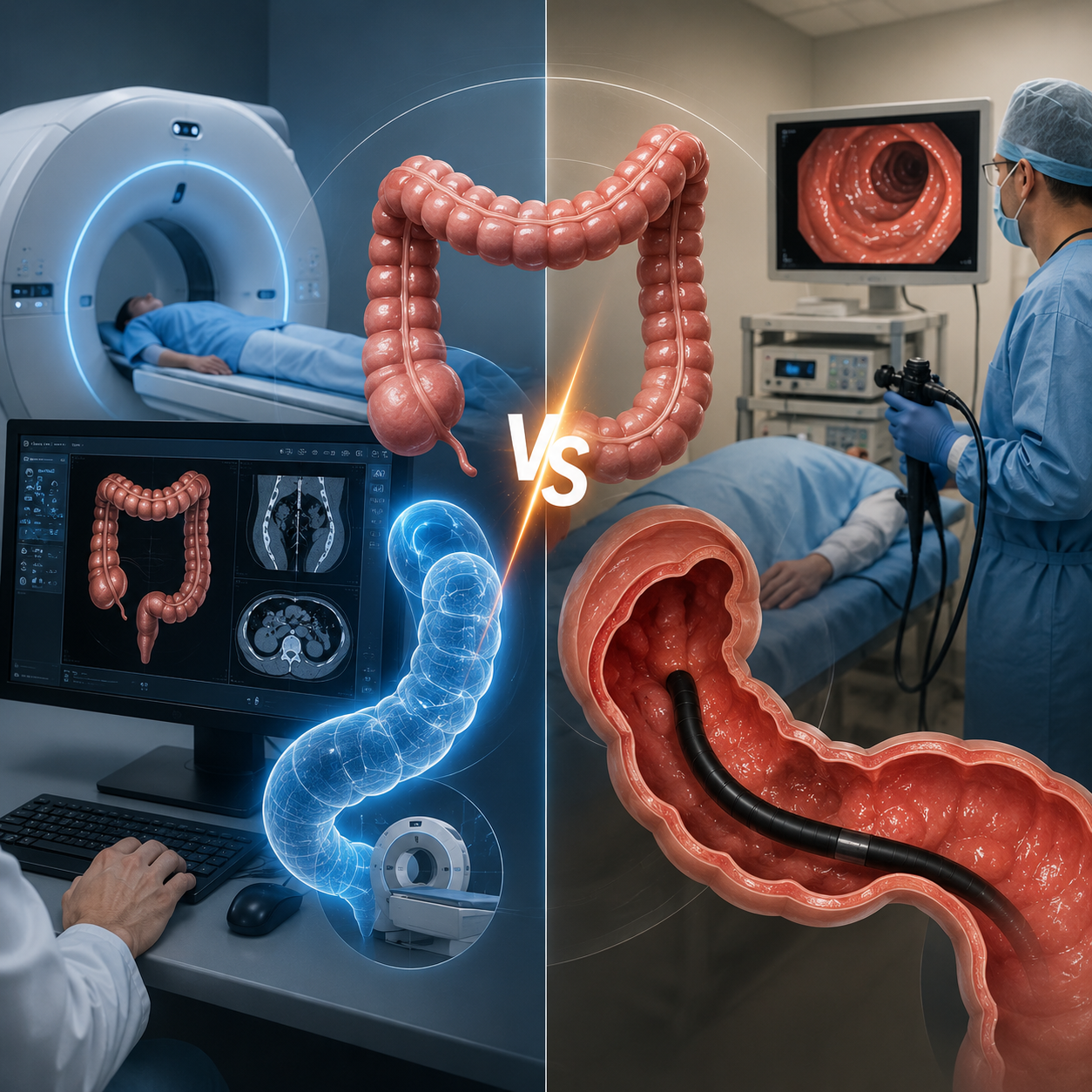
Virtual vs Regular Colonoscopy in Frisco, TX
The American Cancer Society advises that men and women that are age 45 and above to begin screening for colon cancer for at least once every 10 years.
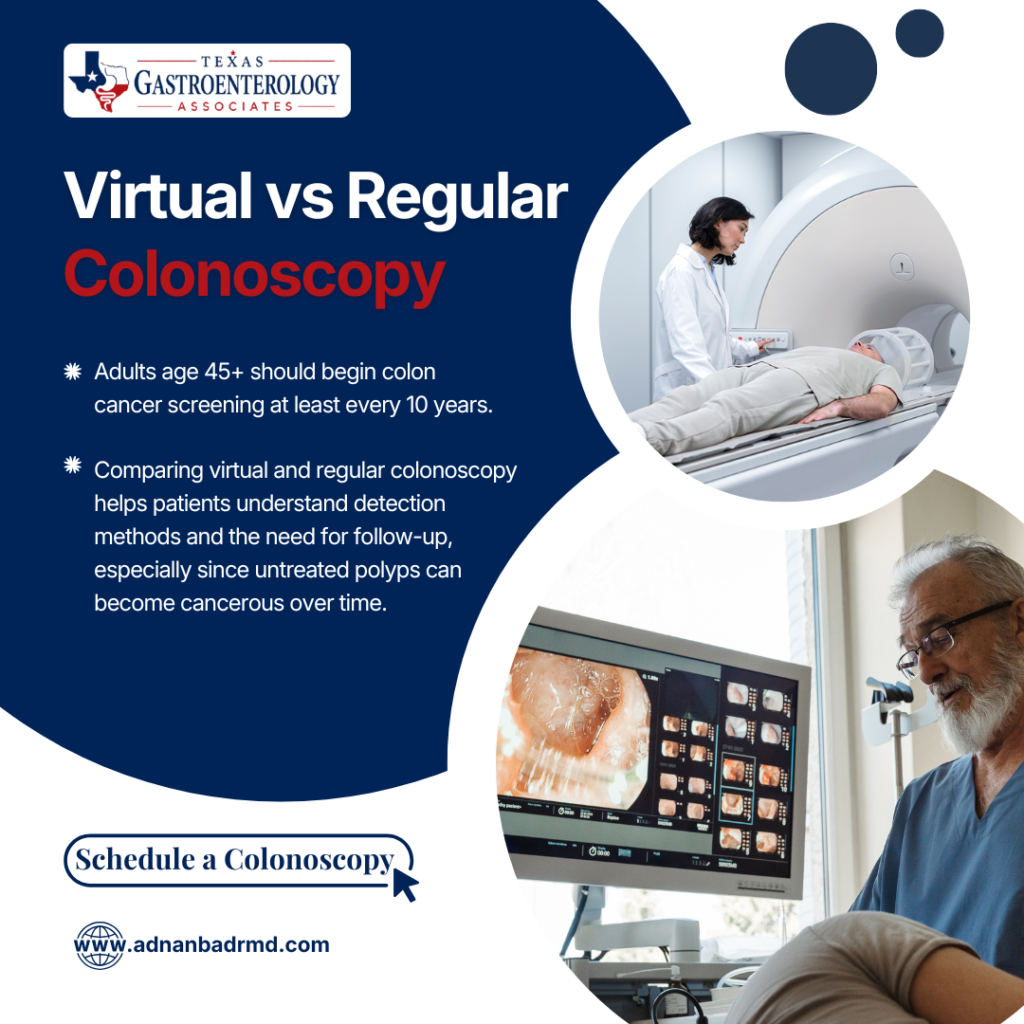
Understanding virtual vs regular colonoscopy in Frisco / Plano, TX can help patients compare how each screening method works, what each test can detect, and whether another procedure may be needed afterward. Noncancerous polyps in the colon can become cancerous over time if they are not removed on time.
Virtual Colonoscopy in Frisco / Plano, TX
Virtual colonoscopy is a medical imaging procedure that uses CT scans to look for polyps or other growths inside your colon.
The x-rays produce two and three-dimensional images of the entire colon and display them on a screen. The doctor views the entire colon on the screen and checks for any polyps or abnormal growths.
Virtual colonoscopy is a less invasive procedure and much safer than conventional colonoscopy.
Regular Colonoscopy in Frisco / Plano, TX
Regular colonoscopy in Frisco / Plano, TX, also known as conventional colonoscopy, uses a flexible colonoscope to examine the colon for polyps, abnormal tissue, bleeding, or other findings.
During a regular colonoscopy, a flexible tube (colonoscope) is inserted into the colon through the rectum. A tiny camera is attached to the tip of the tube for viewing the inside of the colon.
The camera is connected to a screen with which the doctor views the inside of the colon for any available polyps or abnormal growths.
Which is better, a virtual colonoscopy or a regular colonoscopy?
When comparing virtual vs regular colonoscopy in Frisco / Plano, TX, virtual colonoscopy is less invasive and does not typically require sedation, while regular colonoscopy allows polyps or abnormal tissue to be removed during the same procedure.
Let’s take a look at the pros and cons of each.
Pros of virtual colonoscopy
Less invasive
During a virtual colonoscopy, a short thin tube is inserted just into your rectum and your intestine is filled with air through the tube. It is less invasive than a regular colonoscopy.
Fewer complications
Complications during a virtual colonoscopy are fewer and milder as compared to regular colonoscopy. You won’t have to worry about bleeding or tearing of your colon.
More comprehensive
Apart from viewing the inside of your colon, your doctor can view the area outside your colon. It provides a more comprehensive view of your intestine and pelvis area.
It takes shorter time to perform
A virtual colonoscopy takes just about 10-15 minutes to be completed.
It is an alternative to regular colonoscopy
Virtual colonoscopy is an alternative to regular colonoscopy. Individuals that are not good candidates for regular colonoscopy can undergo virtual colonoscopy. Individuals that are on blood thinners can also undergo virtual colonoscopy.
No anesthesia
Virtual colonoscopy does not involve the use of anesthesia. It is more comfortable and without pains
Cons of virtual colonoscopy
Inability to remove polyps
If your doctor finds polyps or any abnormalities, they can’t be removed. You will need to undergo a regular colonoscopy so that the polyps or abnormalities found can be removed.
Radiation exposure
Virtual colonoscopy exposes you to a low dose of radiation during the CT scan.
Pros of regular colonoscopy
Polyp removal
During a regular colonoscopy, your doctor can remove polyps or abnormalities that are found.
Little discomfort
Your doctor will give you anesthesia to make you feel relaxed and comfortable during the exam.
Cons of regular colonoscopy
Complications
Complications of regular colonoscopy are more than virtual colonoscopy. Inserting the tube through the rectum down to the whole length of the colon can cause bleeding of the rectum and tear of the colon.
Longer time
Regular colonoscopy takes a longer time to be completed.
Virtual vs Regular Colonoscopy in Frisco / Plano, TX: Final Comparison:
The choice between virtual vs regular colonoscopy in Frisco / Plano, TX depends on screening needs, medical history, procedure preferences, and whether direct biopsy or polyp removal may be necessary. It is less invasive and faster to perform. However, polyps can’t be removed if found, which is a serious drawback. You will then need to undergo a regular colonoscopy for the polyps to be removed.
Regular colonoscopy on the other hand may have more complications. Though it is more invasive, you will be given anesthesia to make you comfortable throughout the procedure. Any polyps found during the colonoscopy procedure can be removed.
Regular colonoscopy is better recommended than virtual colonoscopy because you won’t need to undergo another procedure to remove polyps if found. If polyps are found during virtual colonoscopy, you will still need to undergo a regular colonoscopy. It is best to undergo a regular colonoscopy to prevent undergoing another procedure.
How Effective Is Virtual Colonoscopy in Frisco / Plano, TX?
Study showed that virtual colonoscopy is able to detect 90% of polyps of 10 millimeters or more in diameter. Virtual colonoscopy has the same accuracy as regular colonoscopy. However, regular colonoscopy is able to detect much smaller polyps (less than 5 millimeters) that virtual colonoscopy may not be able to detect.
How long does a virtual colonoscopy take?
It takes about 10-15 minutes for a virtual colonoscopy to be completed.
How Do You Prepare for Virtual Colonoscopy in Frisco / Plano, TX?
The prep for virtual colonoscopy is the same as the prep for regular colonoscopy.
- You may need to follow a special diet for a few days before your procedure.
- You may need to take your prep or laxatives to clean out your colon for easy viewing.
- You may need to drink a special contrast liquid before the test so that your doctor can see the inside of your colon more clearly.
- Inform your doctor about the medications you’re currently taking including supplements, herbal medications, and vitamins.
- Inform your doctor if you have any allergy to the contrast dye liquid that will be used during the procedure.
- Follow all other instructions that will be given to you by your doctor.
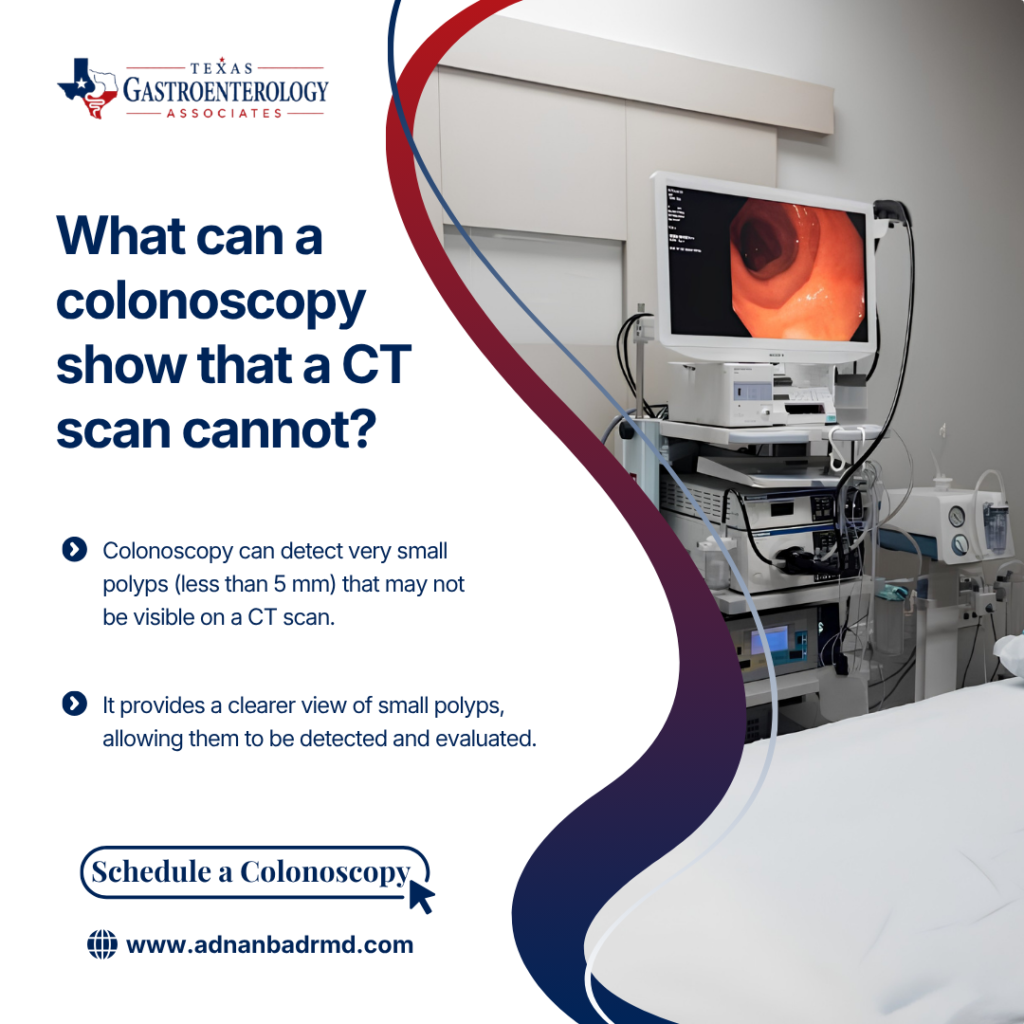
What can a colonoscopy show that a CT scan cannot?
Colonoscopy can show very small polyps of less than 5 millimeters that are not easily seen by CT scan. Very small polyps that are less than 5 millimeters may not be seen by a CT scan but can be seen by colonoscopy.
At what age is a colonoscopy no longer needed?
when to have a colonoscopy, Individuals that are older than age 75 and have been undergoing regular colon cancer screening since age 45 without any polyps or abnormalities found and are not at increased risk of colon cancer may not need to continue routine colonoscopy.
Can virtual colonoscopy detect Crohn’s?
Virtual colonoscopy cannot accurately diagnose Crohn’s disease or other inflammatory bowel diseases. It is not recommended to be used to check for Crohn’s disease.
However, virtual colonoscopy can detect thickened bowel wall and deep ulcers in patients with Crohn’s disease.
Why have a colonoscopy after a CT scan?
A CT scan can detect for the presence of polyps but the polyps can’t be removed. You will need to undergo a colonoscopy after a CT scan to remove polyps.
How long does it take to get results from a CT colonoscopy?
The results from a CT colonoscopy may be available within 2 days or more. Check with your doctor to know the exact time that your results will be available.
Is there an alternative to having a colonoscopy?
Colonoscopy is a common method of screening for colorectal cancer. There are other effective alternatives for screening for colon cancer. These include
Sigmoidoscopy
Sigmoidoscopy is similar to a colonoscopy but does not check the whole of the colon. It checks only a smaller portion of the large intestine. The preparations for a sigmoidoscopy are similar to preparations for a colonoscopy. It is typically less expensive and with fewer risks than colonoscopy.
CT or virtual colonoscopy
CT or Virtual colonoscopy in Frisco / Plano, TX is a medical imaging procedure that uses CT scans to look for polyps or other growths inside the colon.
Fecal immunochemical testing (FIT)
This involves analyzing stool samples. It uses antibodies to detect traces of blood in a stool sample. Traces of blood indicate that there is bleeding or abnormalities in the gastrointestinal tract.
Fecal occult blood testing
This also involves analyzing stool samples. Traces of blood in the stool may indicate abnormalities in the gastrointestinal tract.
Stool DNA
Stool DNA involves analyzing a stool sample to check for blood and specific DNA. A doctor may use stool DNA in combination with FIT.
What are the risks of a colonoscopy?
The risks of a colonoscopy include:
- Tiny tears in the rectum wall or colon
- Bleeding
- Adverse reaction to anesthetic or constraint dye
- Infection
Choose the Right Colonoscopy Option in Frisco / Plano, TX
If you are deciding between virtual and regular colonoscopy, the right choice depends on your age, screening history, symptoms, family history, and whether a biopsy or polyp removal may be needed.
Dr. Adnan Badr MD is a board-certified gastroenterologist serving Frisco / Plano, TX with experience in colonoscopy, polyp detection, and digestive disease evaluation. He can help determine whether a regular colonoscopy in Frisco / Plano, TX or another screening option makes the most sense for your situation.
Schedule a consultation with Dr. Adnan Badr to discuss your colorectal cancer screening needs and the right next step for your care.
Call 972-514-3530 or request an appointment today.