
DIGESTIVE CONDITION FRISCO / PLANO, TX
Crohn’s Disease in Frisco / Plano, TX
Crohn’s disease in Frisco / Plano, TX, can affect different areas of the digestive tract and does not behave the same way in every patient. One person may have inflammation near the end of the small intestine, while another has disease in the colon, around the anus, or in several separated areas.
Barrett’s Esophagus Expertise
Upper Endoscopy On-Site
Board-Certified GI
Symptoms can also be misleading. Diarrhea and abdominal pain may improve while inflammation remains active, or symptoms may return for reasons that are not caused by a Crohn’s flare.
Adnan S. Badr, M.D., provides evaluation and Crohn’s disease treatment in Frisco / Plano, TX, for patients with a new diagnosis, ongoing symptoms, medication concerns, small-bowel involvement, strictures, fistulas, or disease returning after surgery.
How Crohn’s Disease in Frisco / Plano, TX, Is Evaluated
Crohn’s disease can affect any part of the digestive tract and may involve deeper layers of the bowel wall.
Dr. Badr first needs to understand where the disease is located, how much inflammation is present, and whether complications have developed.
Evaluation may include:
- Colonoscopy with biopsies
- Blood tests
- Stool inflammation testing
- CT or MR enterography
- Capsule endoscopy in selected patients
- Review of previous pathology and imaging
- Examination for perianal disease
The disease location can affect symptoms, medication choices, nutrition, and the risk of narrowing or fistula formation.
Planning Crohn’s disease treatment in Frisco / Plano, TX, begins with identifying where inflammation is active, how deeply the bowel is affected, and whether complications such as strictures, fistulas, abscesses, or nutritional deficiencies are present.
A gastroenterologist for Crohn’s disease should not select treatment based only on how often a patient has diarrhea. The full disease pattern matters.
Patients with recurring diarrhea, abdominal pain, unexplained anemia, weight loss, or suspected inflammatory bowel disease may need to see a gastroenterologist in Frisco / Plano, TX.
Mild Symptoms Do Not Always Mean Mild Disease
Some patients feel relatively well even though colonoscopy or imaging still shows ulcers and active inflammation. Others have substantial pain or urgency even when objective inflammation is low.
Care for Crohn’s disease in Frisco / Plano, TX, should be guided by both symptoms and objective findings, because quiet inflammation can continue even when diarrhea, pain, or urgency temporarily improves.
Dr. Badr considers:
- Depth and extent of inflammation
- Disease location
- Strictures, fistulas, or abscesses
- Weight loss and anemia
- Previous steroid use
- Hospitalization history
- Perianal disease
- Age at diagnosis
- Objective inflammation markers
This is why Crohn’s disease treatment in Frisco / Plano, TX, should be guided by both symptoms and objective testing rather than symptom frequency alone.
The goal is to prevent quiet inflammation from causing scar tissue, obstruction, malnutrition, or another complication over time.
The Goal Is Steroid-Free Remission
Short-term relief is important, but long-term treatment should do more than temporarily reduce diarrhea or pain.
The goal of Crohn’s disease treatment in Frisco / Plano, TX, is to control intestinal inflammation, maintain steroid-free remission, prevent complications, and support long-term nutrition and daily function.
Treatment goals may include:
- Reducing intestinal inflammation
- Achieving remission without ongoing steroids
- Improving or healing the bowel lining
- Preventing strictures, fistulas, and abscesses
- Maintaining weight and nutrition
- Reducing hospitalizations
- Lowering the need for surgery
- Supporting normal work and daily activity
Corticosteroids may be used for selected active flares, but they are not intended to become the permanent Crohn’s disease medication plan.
If symptoms return whenever steroids are reduced, Dr. Badr may need to reassess the maintenance treatment.
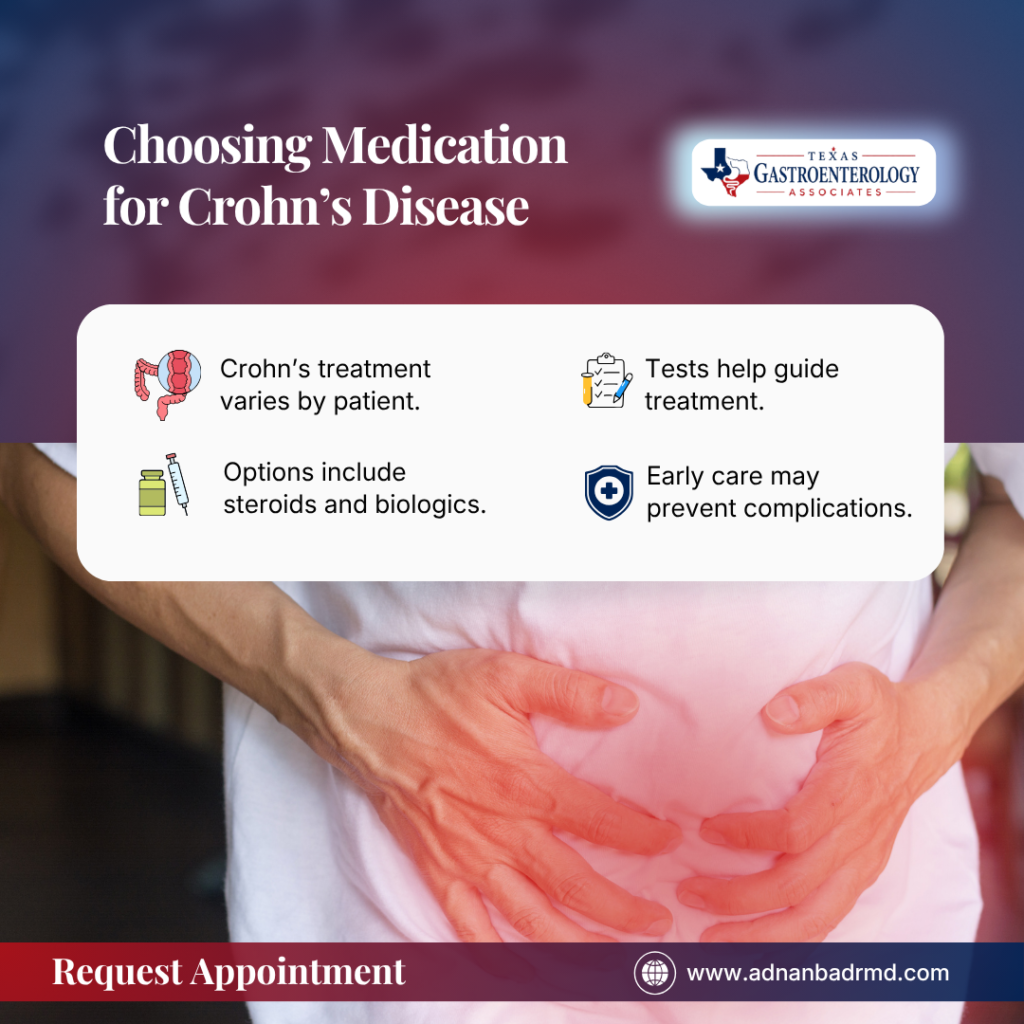
Choosing Medication for Crohn’s Disease in Frisco / Plano, TX
There is no single medication sequence that fits every patient.
Possible treatment categories include:
- Corticosteroids for selected short-term control
- Immunomodulators
- Biologic therapies
- Targeted oral therapies
- Antibiotics for selected infections or complications
- Symptom-supportive medications
Evaluating small-bowel Crohn’s disease in Frisco / Plano, TX, may require MR enterography, CT enterography, capsule endoscopy, nutritional testing, and inflammatory markers.
The choice may depend on disease location, complication risk, previous medication exposure, infection history, pregnancy plans, other health conditions, and patient preference.
A Crohn’s disease doctor in Frisco may recommend an advanced therapy earlier when the disease has features associated with a greater risk of progression.
This does not mean the patient has failed treatment. It may mean the goal is to control inflammation before permanent damage develops.
Biologic and Targeted Therapy
Biologic treatment for Crohn’s disease works on specific inflammatory pathways. These medications are not simply stronger versions of pain or diarrhea medicine.
They may be considered when:
- Inflammation is moderate or severe
- Steroids are repeatedly needed
- Fistulas or penetrating disease are present
- Previous medication has not controlled the disease
- The patient has a higher risk of progression
Before treatment, care may include infection screening, vaccination review, laboratory testing, and discussion of possible risks.
Biologic treatment for Crohn’s disease also requires follow-up to determine whether symptoms and objective inflammation are improving.
Feeling better is encouraging, but Dr. Badr may still use stool markers, bloodwork, imaging, or endoscopy to check the disease itself.
Why Steroids Should Not Become the Default Flare Plan
Steroids may work quickly, but repeated or prolonged use can create significant health risks.
Needing frequent steroid courses may indicate that:
- Maintenance therapy is not controlling inflammation
- A medication has lost effectiveness
- An infection is causing symptoms
- A stricture or abscess has developed
- The source of the symptoms needs to be reconsidered
Crohn’s disease flare treatment should begin by confirming what is driving the change.
Automatically prescribing another steroid course without checking for infection or complications may delay the right treatment.
Symptoms Returning May Not Mean Active Inflammation
Diarrhea, bloating, urgency, or abdominal pain may come from several causes besides an inflammatory flare.
Possible explanations include:
- Intestinal infection
- Irritable bowel syndrome
- Bile-acid diarrhea
- Medication side effects
- Small intestinal bacterial overgrowth
- Scar-related narrowing
- Food intolerance
- Poor nutrient absorption
- Changes after bowel surgery
Persistent symptoms with Crohn’s disease should be investigated before immune treatment is automatically increased.
Dr. Badr may use blood tests, stool testing, imaging, or endoscopy to determine whether inflammation is active or whether another problem is present.
Small-Bowel Crohn’s Disease
Small-bowel Crohn’s disease may not be fully visible during a standard colonoscopy in Frisco / Plano, TX.
Evaluating small-bowel Crohn’s disease in Frisco / Plano, TX may require MR enterography, CT enterography, capsule endoscopy, nutritional testing, and inflammatory markers.
Small-bowel disease may contribute to:
- Cramping after meals
- Weight loss
- Iron or vitamin deficiencies
- Narrowing
- Partial obstruction
- Fistula formation
Capsule endoscopy can provide useful images of the small intestine, but it may not be appropriate when narrowing is suspected because the capsule could become retained.
The safest test depends on the symptoms and previous imaging.
Crohn’s Disease Strictures
A Crohn’s-related stricture may be caused by active inflammation, established scar tissue, or a combination of both.
An inflammatory narrowing may improve when inflammation is controlled. A fixed fibrotic stricture usually does not disappear with medication alone.
Crohn’s disease stricture treatment may involve:
- Medication adjustment
- Cross-sectional imaging
- Temporary dietary modification
- Endoscopic dilation for selected short strictures
- Surgical consultation
Crohn’s disease stricture treatment must match the type, length, location, and severity of the narrowing.
Increasing cramping, abdominal swelling, vomiting, or inability to pass stool or gas may indicate obstruction and requires prompt medical attention.
Fistulas and Abscesses
Deeper Crohn’s inflammation can create an abnormal connection between the bowel and nearby tissue.
Fistulas may involve the skin around the anus, another bowel loop, the bladder, or other structures.
Fistulizing Crohn’s disease treatment may require a combination of imaging, antibiotics, abscess drainage, biologic therapy, gastroenterology care, and colorectal surgery.
Fistulizing Crohn’s disease treatment is not the same as treating routine diarrhea or abdominal discomfort.
An abscess often needs drainage. Medication alone may not safely control an undrained collection of infection.
Food and Nutrition
There is no single everyday diet that cures Crohn’s disease.
Food needs may change based on:
- Active inflammation
- Strictures
- Diarrhea
- Weight loss
- Previous surgery
- Nutrient deficiencies
- Individual tolerance
During an active flare or obstructive period, temporary dietary changes may be recommended. These should not automatically become permanent restrictions.
Diet can support nutrition and reduce selected symptoms, but it should not replace effective inflammatory bowel disease treatment.
Patients with weight loss, limited food intake, or multiple restrictions may benefit from working with a registered dietitian experienced in inflammatory bowel disease treatment.
Monitoring Can Find Inflammation Before Symptoms Worsen
Crohn’s disease monitoring may involve:
- Blood counts and metabolic testing
- C-reactive protein
- Fecal calprotectin
- Medication safety laboratories
- Colonoscopy
- Imaging
- Nutritional markers
- Weight and symptom review
A normal blood test alone does not prove that the disease is fully controlled.
Monitoring Crohn’s disease in Frisco / Plano, TX, helps Dr. Badr compare how the patient feels with bloodwork, stool markers, imaging, colonoscopy findings, weight, and nutritional health.
This can identify ongoing inflammation before another severe flare or complication develops.
When a Medication Stops Working
Loss of response may occur because the inflammatory pathway is no longer adequately controlled, the body clears the medicine too quickly, or antibodies develop against selected biologic drugs.
Other possibilities include inconsistent dosing, infection, a stricture, or symptoms unrelated to active inflammation.
Dr. Badr may recommend objective testing, medication-level testing in selected cases, dose adjustment, switching therapy, or treating a complication.
Changing medication does not mean the patient has run out of options.
Surgery Does Not Cure Crohn’s Disease
Surgery may be needed for obstruction, fibrotic strictures, abscesses, fistulas, perforation, severe bleeding, or disease that does not respond adequately to medical treatment.
It may remove a damaged bowel segment or correct a serious complication.
However, Crohn’s inflammation can return near the surgical connection or elsewhere in the digestive tract.
Crohn’s disease after surgery still requires follow-up. Care may include medication, colonoscopy, imaging, nutritional monitoring, and evaluation for early recurrence.
Crohn’s disease after surgery is often easier to manage when inflammation is identified before major symptoms return.
When Symptoms Require Urgent Care
Seek prompt medical care for:
- Severe or rapidly worsening abdominal pain
- Persistent vomiting
- Significant abdominal swelling
- Inability to pass stool or gas
- High fever or chills
- Heavy rectal bleeding
- Black stool
- Fainting or marked weakness
- Severe pain or swelling near the anus
- Signs of dehydration
These symptoms may indicate obstruction, infection, abscess, bleeding, or another complication rather than a routine flare.
ANSWERS TO COMMON QUESTIONS
Frequently Asked Questions
There is no current medical or surgical cure. Treatment aims to control inflammation, maintain remission, prevent complications, and support long-term quality of life.
Not every patient does. The decision depends on disease severity, location, previous treatment, complication risk, other health conditions, and personal preferences.
No. Both are inflammatory bowel diseases, but they differ in location, depth of inflammation, and the complications they may cause.
Diet can support nutrition and reduce selected symptoms, but it should not replace effective treatment for active intestinal inflammation.
Possible causes include IBS, infection, bile-acid diarrhea, medication effects, bacterial overgrowth, food intolerance, or changes after bowel surgery.
Yes. Surgery treats damaged areas and complications, but inflammation may return near the surgical connection or elsewhere.
Do not stop treatment without medical guidance. Symptoms may improve before the underlying inflammation is fully controlled.

Schedule a Crohn’s Disease Treatment in Frisco / Plano, TX, With Dr. Adnan S. Badr
If Crohn’s disease has recently been diagnosed, symptoms are returning, medication is no longer controlling inflammation, or testing has found small-bowel involvement, a stricture, or a fistula, Dr. Adnan S. Badr can review the full disease history.
Dr. Badr can help determine the next step for Crohn’s disease treatment in Frisco / Plano, TX, based on disease location, inflammation, previous medication response, complications, nutritional concerns, and overall health.
Frisco
4500 Hillcrest Rd, Ste 185, Frisco, TX 75035
Plano
5800 Communications Parkway, Plano, TX 75093
Phone
(972) 514-3530 · Fax (972) 514-3531
Hours
Mon–Thu 8:00 AM–4:30 PM · Fri 8:00 AM–4:00 PM