Colonoscopy vs Stool Tests in Frisco/Plano, TX
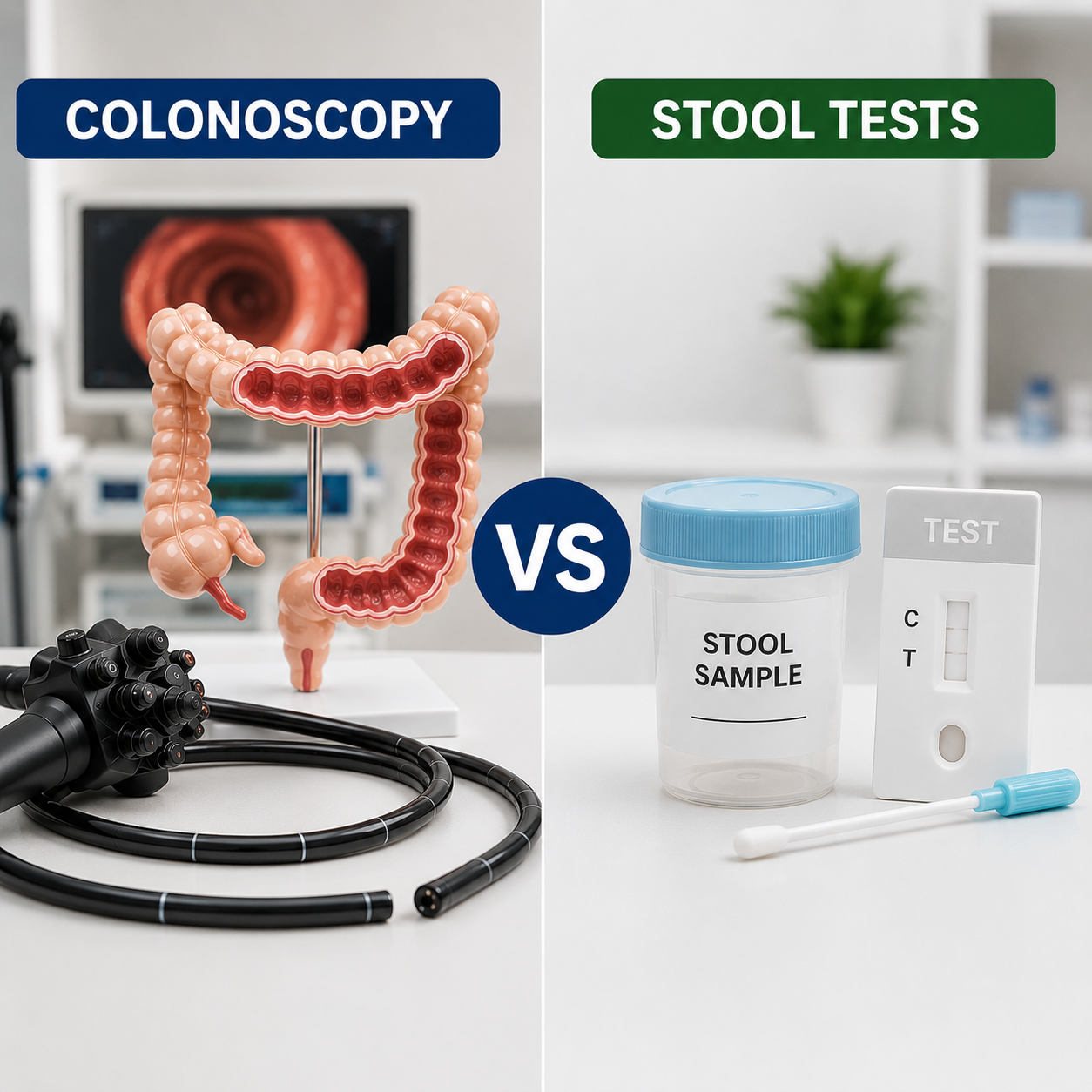
Colonoscopy vs stool tests is an important comparison for patients considering colorectal cancer screening in Frisco/Plano, TX. Both colonoscopy and stool-based tests can check for signs of colorectal cancer, but they work differently in accuracy, polyp detection, and prevention.
How Do Colonoscopy vs Stool Tests Differ?
Colonoscopy in Frisco/Plano, TX
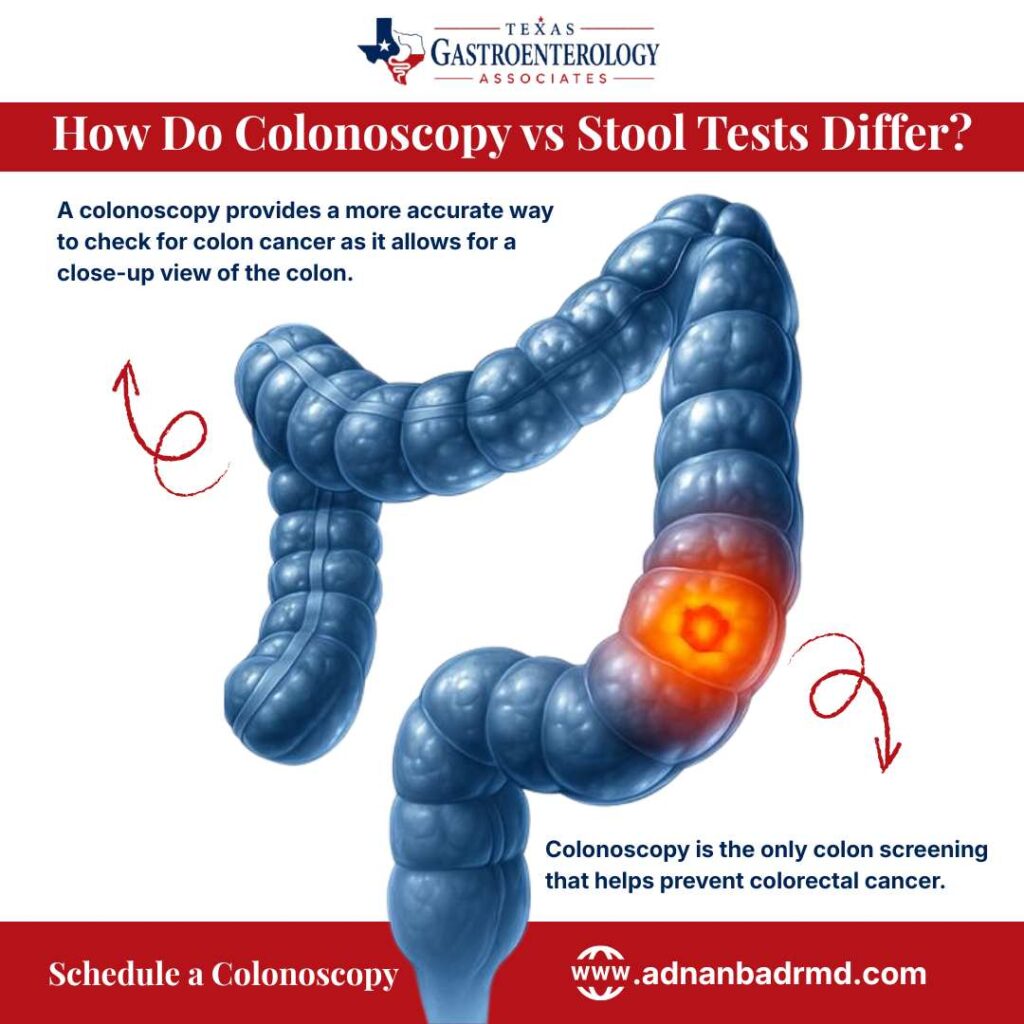
A colonoscopy provides a more accurate way to check for colon cancer as it allows for a close-up view of the colon.
Colonoscopy is the only colon screening that helps prevent colorectal cancer. A colonoscopy is usually done to check for precancerous polyps before they become cancerous. During a colonoscopy screening, precancerous polyps are removed if found in the colon. This helps to prevent colorectal cancer from forming.
A colonoscopy is done using a long, flexible tube called a colonoscope. The tube has a light and a tiny camera on one end that allows your provider to see the inside of your colon on a monitor.
The tube is passed through your rectum and moved into your colon. Surgical tools can also be passed through the tube if precancerous polyps are found.
During a colonoscopy procedure:
You will be asked to remove your clothing and jewelry and put on a hospital gown
A sedative or a pain medicine will be administered to you intravenously. The IV line will be inserted into your arm or the back of your hand.
Your provider will monitor your heart rate, blood pressure, respiratory rate and oxygen level.
You may be given oxygen to assist your breathing.
Your provider will ask you to lie on your left side with your knees pulled up towards your chest to allow easy access to your anus.
A lubricated colonoscope will be inserted into your anus and passed through into your rectum and colon. You may feel mild pain, pressure or cramping at this time.
You may be completely asleep or awake during the procedure. If you’re awake, you may be asked to take slow, deep breaths while the colonoscope is being inserted into your anus and passed through into your colon to help relax your abdominal muscles and reduce discomfort.
Air may be injected into your bowel through the colonoscope to make viewing the inside of your colon easier. A water jet may also be used to clean the lining of your colon, while a suction device may be used to remove any liquid stool to see the inside of your colon more clearly.
Your provider will view your colon on a monitor connected to the tiny camera inside your colon. Photos may also be taken. If a precancerous polyp is found in the colon, it will be removed.
The colonoscope will be gently withdrawn after the procedure is completed.
Stool-based tests in Frisco/Plano, TX
Stool tests are usually recommended for patients who are experiencing symptoms of colorectal cancer, such as blood in the stools, narrow or thin stools, changes in bowel movements, and abdominal discomfort.
Stool tests are ordered to confirm a diagnosis of colorectal cancer. They help detect colorectal cancer when it’s already present in the colon or rectum.
Three types of stool tests are approved by the U.S. Food and Drug Administration (FDA) to screen for colorectal cancer. These include:
Guaiac FOBT (gFOBT)
This is a common type of fecal occult blood test. The guaiac test checks for hidden blood in a stool sample. It can find blood even if you cannot see the blood with your naked eyes.
Fecal immunochemical test (FIT) or fecal occult blood test (FOBT)
These tests are used to check stool samples for hidden traces of blood, which can be an early sign of colorectal cancer.
Multi-targeted stool DNA testing
This test uses a sample of your stool to check for cell DNA changes that might indicate that colon cancer or a precancerous condition is present. The stool DNA test also looks for blood in a stool sample.
What are the main differences between Colonoscopy vs Stool Tests in Frisco/Plano, TX?
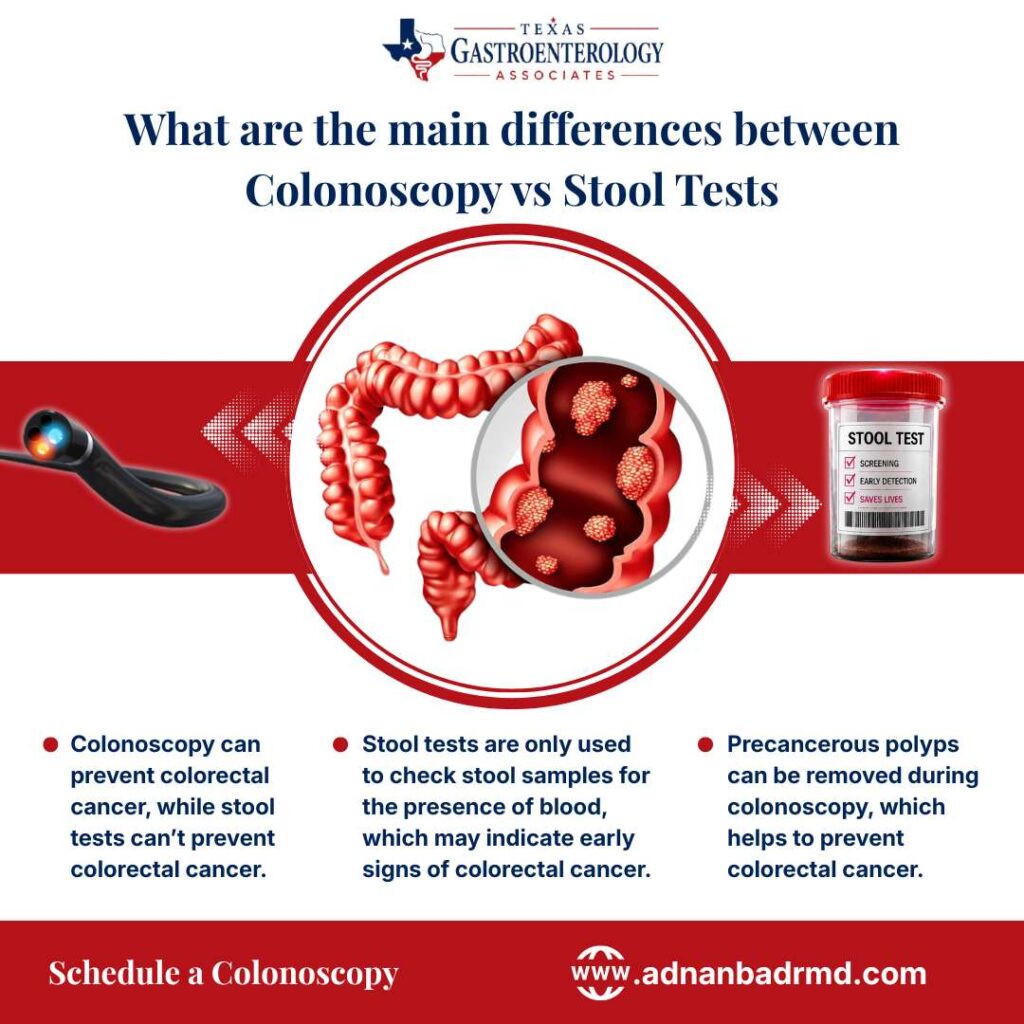
Colonoscopy can prevent colorectal cancer, while stool tests can’t prevent colorectal cancer. Precancerous polyps can be removed during colonoscopy, which helps to prevent colorectal cancer. Stool tests are only used to check stool samples for the presence of blood, which may indicate early signs of colorectal cancer.
Colonoscopy is more accurate than stool testing. A colonoscopy provides a clear view of the entire colon. Your provider can view the inside of your colon on a monitor for any abnormal growth or polyps. It is the most accurate way to get a close-up view of your colon and rectum.
Stool testing only checks the stool for the presence of blood, which could indicate early signs of colon cancer. However, not all stool tests are right. A stool test may not detect colon cancer in eight out of 100 individuals.
Stool-based tests cannot detect most precancerous polyps. Hence, they become cancerous over time. This test can miss precancerous polyps more than 50% of the time.
Colonoscopy can help increase the survival rates of individuals with precancerous polyps. When the colon is checked, and precancerous polyps are found, they are removed. This increases the survival rates of individuals with precancerous polyps.
On the other hand, stool tests detect the presence of colon cancer. This can mean the disease is already in a later stage, making it more challenging to treat.
You may still need to get a colonoscopy in Frisco/Plano, TX, even after a stool-based test. A positive result after a test usually means you need a colonoscopy to determine if precancerous polyps or colon cancer are present in the colon.
How effective is a stool test at detecting colon issues?
Accuracy is one of the main reasons patients compare colonoscopy vs stool tests before choosing a screening option. Stool tests can effectively detect colon cancer but are not 100% accurate. Research shows stool DNA testing is 92% effective at detecting colon cancers. However, stool DNA tests return more false positives than fecal immunochemical tests (FIT). FIT is about 79% accurate at detecting colon cancers.
FAQ
When comparing colonoscopy vs stool tests, stool testing cannot fully replace colonoscopy for colon health screening.
A colonoscopy is the gold standard for colon health screening. Stool-based tests can’t take the place of colonoscopy for colon health screening because they’re not 100% accurate and can only detect the presence of colon cancer in stool samples. Colonoscopy can help prevent colon cancer with early screening and removal of precancerous polyps.
When should you opt for colonoscopy instead of stool testing?
Your risk of developing colon cancer increases if a family member has a history of colon cancer or you have a history of colon polyps. Doctors only recommend a colonoscopy if you have an average risk of developing colon cancer. You should opt for a colonoscopy if you have an average risk of developing colon cancer.
What is the timing of these tests? How often do you need them?
The timing and frequency of colon cancer screening can vary based on individual risk factors for developing colon cancer. Individuals with high risk factors may need to get colon cancer screening earlier than age 45 and more frequently. Individuals with average risk factors can get colon cancer screening at age 45 and above with less frequency.
Generally, a colonoscopy screening is recommended for healthy individuals aged 45 and above once every ten years. If your risk of colon cancer increases, you may need to get a colonoscopy once every five years.
The FIT and fecal DNA tests are recommended once every 1-3 years, depending on your risk factors.
How accurate is each type of test in detecting cancer?
Colonoscopy is about 95-99% accurate in detecting colon cancer. The multi-targeted stool DNA test is 92% accurate in detecting colon cancer, while the fecal immunochemical test (FIT) is about 79% accurate in detecting colon cancer.
Why colonoscopy offers a better screening choice than stool tests
Colonoscopy provides a better screening choice than stool tests because it can be used to view the entire colon for the presence of precancerous polyps or abnormal growth. It provides the only way to view the colon and remove polyps if found. It helps to prevent colon cancer as doctors can precancerous polyps before they turn cancerous.
Colonoscopy can make a difference in individuals with a family or personal medical history of colon cancer. The screening can be a turnaround point for them as precancerous polyps can be removed during the screening.
Colonoscopy can help increase the survival rates of individuals with precancerous polyps. Precancerous polyps are removed if found in the colon during a colonoscopy in Frisco/Plano, TX, increasing the survival rates of individuals with precancerous polyps.
Stool-based tests check stool samples to detect the presence of blood, which could indicate colon cancer. The disease could already be in its later stage, making it more difficult to treat and reducing the survival rates of patients.
Get Your Colon Cancer Screening with Dr. Adnan Badr MD in Frisco/Plano, TX
Early screening for colon cancer is recommended, particularly if you’re at a higher risk of developing the disease.
Getting colon cancer screening from a qualified and experienced endoscopist in Frisco/Plano, TX, like Dr. Adnan Badr, MD /Plano, TX, can help you take the next step with the right evaluation and guidance.
Dr. Adnan Badr’s Frisco office is located at:
4500 Hillcrest Dr. Ste 185
Frisco, TX 75035
Phone: 972-514-3530
Fax: 972-514-3531
Contact Dr. Adnan Badr MD today to schedule an appointment for your colonoscopy in Frisco/Plano, TX.