
GASTROINTESTINAL PROCEDURE FRISCO / PLANO, TX
Achalasia in Frisco, TX
When both food and liquids begin hesitating behind the breastbone, eating can become slow and unpredictable. Achalasia in Frisco, TX may need to be considered when swallowing difficulty affects both solids and liquids, food returns into the throat, or meals take increasingly longer to finish.
Barrett’s Esophagus Expertise
Upper Endoscopy On-Site
Board-Certified GI
Achalasia is an esophageal movement disorder. The lower esophageal sphincter does not relax normally, and the esophagus loses the coordinated activity that should move food into the stomach.
Adnan S. Badr, M.D., evaluates patients seeking achalasia treatment in Frisco, TX, including those with a new diagnosis, abnormal manometry results, or symptoms returning after previous care.
Why Achalasia in Frisco, TX May Be Mistaken for Reflux
Patients may describe regurgitation as “reflux,” although the material coming back may be food that never entered the stomach. Solid-food difficulty can also resemble a stricture, Schatzki ring, or eosinophilic esophagitis.
Patterns that raise concern for achalasia include:
- Difficulty swallowing solids and liquids
- Regurgitation of undigested food
- Pressure behind the breastbone
- Nighttime coughing or choking
- Meals taking longer
- Progressive weight loss
Symptoms can suggest a motility problem, but they cannot confirm the diagnosis.
How Achalasia in Frisco, TX Is Diagnosed
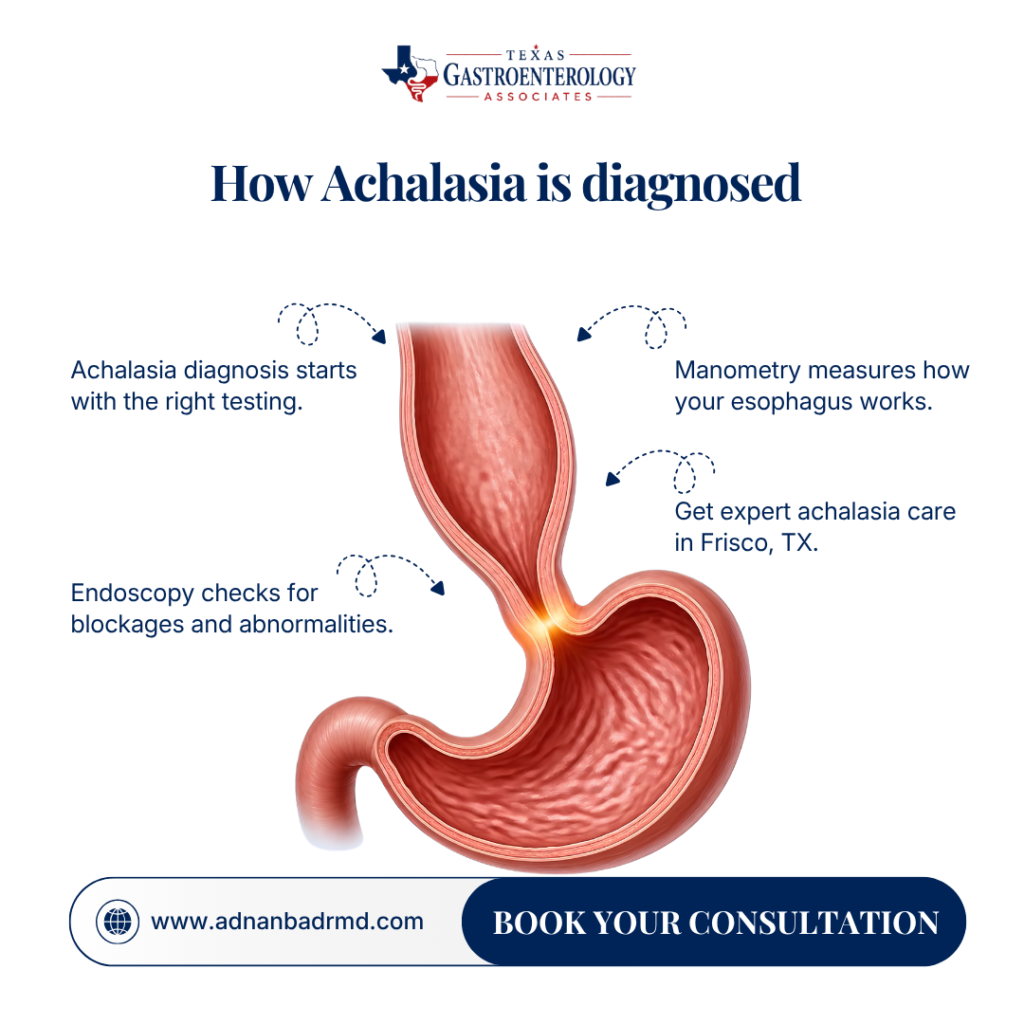
An upper endoscopy checks for a physical obstruction, inflammation, stricture, retained food, or abnormal tissue.
High-resolution esophageal manometry measures contractions and lower-sphincter relaxation. It is the main test used for achalasia diagnosis and classification.
A timed barium esophagram shows how quickly swallowed material leaves the esophagus. It may reveal delayed emptying, widening, or narrowing near the stomach.
Additional imaging may be needed when age, rapid progression, or weight loss raises concern that another condition is creating an achalasia-like blockage.
Type I, Type II, and Type III Achalasia in Frisco, TX
Manometry can identify three main patterns.
Type I involves little or no useful contraction in the esophageal body.
Type II causes pressure to build through much of the esophagus after swallowing.
Type III includes premature or spastic contractions along with poor lower-sphincter relaxation.
The subtype can influence treatment. Type III achalasia treatment often requires a longer muscle division to address the spastic segment, which is one reason POEM may be considered.
Dr. Badr also considers symptoms, esophageal shape, previous treatment, and overall health.
What Treatment Is Trying to Change
Current treatment cannot restore damaged esophageal nerves or normal contractions. The goal is to reduce resistance at the lower sphincter so food and liquid can enter the stomach more easily.
Treatment planning for achalasia in Frisco, TX focuses on helping food and liquids pass into the stomach more easily while considering the achalasia subtype, symptom severity, esophageal shape, previous treatment, and risk of reflux.
Treatment may improve swallowing, regurgitation, chest pressure, nighttime coughing, food retention, and the ability to maintain weight.
It cannot guarantee normal movement, permanent relief, or freedom from reflux. When discussing achalasia treatment in Frisco, TX, the goal is meaningful improvement in emptying and daily eating—not a promise that the esophagus will function normally again.
Choosing Between POEM in Frisco, TX, Pneumatic Dilation, and Surgery
There is no single best option for every patient. Dr. Badr may consider:
- Achalasia subtype
- Age and general health
- Symptom severity
- Degree of esophageal widening
- Previous treatment
- Spastic contractions
- Reflux concerns
- Ability to undergo anesthesia or surgery
- Patient preference
The main durable options are POEM, pneumatic dilation, and laparoscopic Heller myotomy. Each lowers resistance at the lower sphincter in a different way.
POEM for Achalasia in Frisco, TX
POEM stands for peroral endoscopic myotomy. It is performed through the mouth without an external abdominal incision.
An endoscope enters the esophagus, a tunnel is created within the esophageal wall, and selected muscle fibers are divided. This allows the lower sphincter to open more easily.
POEM for achalasia may be considered because the muscle division can be tailored, a longer myotomy can address spastic disease, and it may remain an option after certain previous treatments.
It is often a strong option for Type III disease, but it is not automatically best for every patient. Reflux can occur afterward and may require medication or follow-up testing.
Pneumatic Dilation for Achalasia in Frisco, TX
Pneumatic dilation for achalasia is different from routine dilation for a benign stricture.
A specialized balloon is positioned across the lower sphincter and inflated with controlled force to disrupt selected muscle fibers. Some patients improve after one session, while others need graded treatment with larger balloons.
Important considerations include perforation risk, the possibility of repeat treatment, age, subtype, and previous therapy.
Heller Myotomy for Achalasia
Heller myotomy for achalasia is a surgical treatment. A surgeon divides tight muscle fibers at the lower esophagus and upper stomach. A partial fundoplication may be added to reduce reflux.
POEM and Heller myotomy have a similar physiologic goal but use different access routes. The choice depends on anatomy, subtype, prior care, surgical fitness, reflux concerns, and patient preference.
Why Reflux Can Develop After Treatment
Achalasia treatment in Frisco, TX, opens a sphincter that was not relaxing. Once that barrier is reduced, stomach contents may move upward more easily.
Some patients develop heartburn, acid regurgitation, esophagitis, or reflux seen on testing without obvious symptoms.
Reflux does not automatically mean achalasia has returned. POEM, pneumatic dilation, and Heller myotomy have different reflux considerations, but all require appropriate follow-up.
Why Symptoms Can Return
Recurrent achalasia after treatment can result from:
- Incomplete muscle division
- Scar formation
- Persistent sphincter resistance
- Progressive esophageal widening
- Reflux-related narrowing
- Food retention despite an open sphincter
- A different swallowing disorder
Recurrent achalasia after treatment does not automatically mean the first procedure failed.
Evaluation may include repeat endoscopy, timed barium testing, manometry, reflux testing, or review of the original procedure. Selected patients may still be candidates for POEM, pneumatic dilation, or another intervention.
When an Enlarged Esophagus Changes the Plan
Long-standing achalasia can leave the esophagus widened, curved, and less effective at emptying.
Food may remain even after sphincter pressure is reduced, and regurgitation, aspiration risk, or poor nutrition may continue. These patients need an individualized plan.
In rare end-stage cases, removal of the esophagus may be discussed when other therapies are no longer appropriate. This is not routine care for newly diagnosed achalasia in Frisco, TX.
Ongoing Monitoring Still Matters
Follow-up may include reviewing swallowing and regurgitation, monitoring weight, checking reflux symptoms, and repeating endoscopy or timed barium testing when indicated.
Contact Dr. Badr if you begin avoiding food again, need increasing amounts of liquid to swallow, develop nighttime regurgitation, or lose weight unexpectedly.
When Swallowing Symptoms Need Urgent Care
Seek urgent care if you cannot swallow saliva, have a complete food impaction, begin drooling, develop breathing difficulty, experience severe chest pain, repeatedly vomit, or show signs of dehydration.
Do not try to force trapped food downward with more food or large amounts of liquid.
ANSWERS TO COMMON QUESTIONS
Frequently Asked Questions
Treatment improves passage through the lower sphincter but does not restore damaged nerves. Symptoms may remain controlled for years, although follow-up or retreatment can be needed.
Neither is best for everyone. The choice depends on subtype, previous treatment, anatomy, reflux concerns, overall health, specialist experience, and patient preference.
Achalasia requires treatment directed at the lower sphincter. Pneumatic dilation is different from routine dilation used for benign esophageal strictures.
Yes, but relief is usually less durable. It is commonly reserved for patients who are not good candidates for POEM, pneumatic dilation, or surgery.
Reflux can occur after the lower sphincter is opened. Medication, endoscopy, or reflux testing may be recommended according to symptoms and treatment type.
Symptoms can return because of scarring, incomplete muscle division, reflux-related narrowing, advanced esophageal changes, or another condition. Testing is needed before retreatment.
Yes. Patients may eat less because swallowing is difficult, meals take longer, or food does not enter the stomach efficiently.

Schedule an Achalasia Treatment in Frisco, TXWith Dr. Adnan S. Badr
If solids and liquids are becoming difficult to swallow, testing has confirmed achalasia, or symptoms have returned after treatment, Dr. Adnan S. Badr can review the manometry, endoscopy, imaging, and prior records.
He can help determine whether POEM, pneumatic dilation, surgery, Botox, or another next step is appropriate for achalasia treatment in Frisco, TX.
Frisco
4500 Hillcrest Rd, Ste 185, Frisco, TX 75035
Plano
5800 Communications Parkway, Plano, TX 75093
Phone
(972) 514-3530 · Fax (972) 514-3531
Hours
Mon–Thu 8:00 AM–4:30 PM · Fri 8:00 AM–4:00 PM