
GASTROINTESTINAL PROCEDURE · FRISCO / PLANO, TX
Capsule Endoscopy in Frisco & Plano, TX
Unexplained anemia, ongoing blood loss, dark stool, or digestive symptoms that continue after an upper endoscopy and colonoscopy can leave patients with more questions than answers. Capsule endoscopy in Frisco & Plano, TX can help examine the small intestine when standard scopes have not identified the source of unexplained bleeding, anemia, or ongoing digestive symptoms.
Barrett’s Esophagus Expertise
Upper Endoscopy On-Site
Board-Certified GI
Capsule endoscopy uses a small, swallowable camera to collect images as it moves naturally through the digestive tract. The test is sometimes called video capsule endoscopy, small bowel capsule endoscopy in Frisco/Plano, TX, or a pill camera test.
Adnan S. Badr, M.D., may recommend capsule endoscopy in Frisco & Plano, TX. when he needs a closer look at the small intestine for possible bleeding, inflammation, ulcers, Crohn’s disease, or another abnormality that has not been identified through previous testing.
Why You May Need Capsule Endoscopy in Frisco & Plano, TX
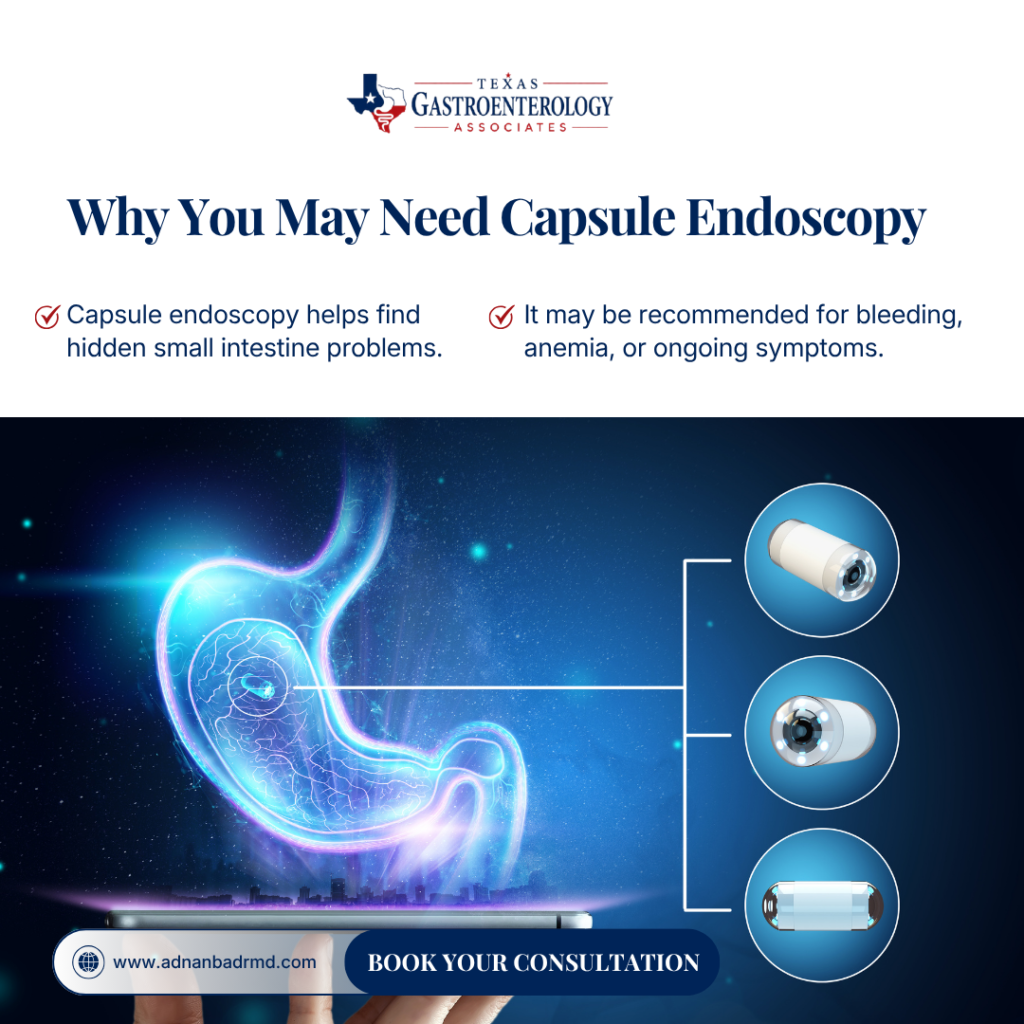
Capsule endoscopy is not used for every stomachache, episode of bloating, or change in bowel habits. It is generally considered when there is a specific reason to examine the small intestine more closely.
Dr. Badr may recommend the test for concerns such as:
- Unexplained gastrointestinal bleeding
- Iron-deficiency anemia without a clear source
- Recurrent black or tarry stool
- Blood loss that continues after previous testing
- Possible Crohn’s disease involving the small intestine
- Suspected small-bowel inflammation or ulceration
- An abnormality found on imaging or another diagnostic test
- Persistent symptoms after an upper endoscopy and colonoscopy have not provided an answer
One of the most common reasons for capsule endoscopy in Frisco & Plano, TX is suspected small-bowel bleeding. An upper endoscopy examines the esophagus, stomach, and beginning of the small intestine, while a colonoscopy examines the colon and sometimes the very end of the small intestine.
The capsule travels through the area between them, helping Dr. Badr investigate a section of the digestive tract that is otherwise difficult to examine directly.
What Part of the Digestive Tract Does the Capsule Examine?
The small intestine is a long, winding section of the digestive system located between the stomach and colon. It plays an important role in digestion and nutrient absorption, but much of it lies beyond the reach of a standard upper endoscope or colonoscope.
During a small bowel capsule endoscopy in Frisco & Plano, TX, the camera captures images as it moves through this area.
Although the capsule may also take pictures while passing through the stomach and colon, its main purpose is usually to examine the small intestine.
This is why the procedure is different from an EGD or colonoscopy in Frisco & Plano, TX. Each test answers a different question and examines a different part of the digestive tract.
What the Pill Camera Can and Cannot Do
A pill camera test can provide a detailed visual record of the small-bowel lining. As the capsule moves forward, it takes thousands of images and sends them to a recorder worn by the patient.
The images may help Dr. Badr identify:
- Possible bleeding sites
- Small ulcers
- Areas of inflammation
- Abnormal blood vessels
- Polyps or growths
- Changes that may suggest Crohn’s disease
- Areas of narrowing
- Other unusual findings in the small intestine
However, the camera capsule has important limitations.
It cannot take a biopsy, remove a polyp, stop bleeding, stretch a narrowing, or collect tissue. Dr. Badr also cannot steer the capsule or move it backward to look at an area again.
Capsule endoscopy is primarily a diagnostic test. When it identifies an abnormality, another procedure may be required to confirm the finding or provide treatment.
Capsule Endoscopy for Small-Bowel Bleeding and Anemia
Small-bowel bleeding does not always cause obvious red blood in the stool. In some patients, blood loss happens slowly and may only become noticeable through laboratory results or symptoms of anemia.
Possible signs include:
- Persistent fatigue
- Weakness
- Shortness of breath with activity
- Dizziness
- Recurrent black stool
- Low iron levels
- Blood counts that improve and then drop again
- A continued need for iron treatment
Capsule endoscopy for anemia may be considered when Dr. Badr suspects gastrointestinal blood loss but an upper endoscopy and colonoscopy have not shown the source.
The pill camera may reveal ulcers, inflammation, abnormal blood vessels, polyps, or another lesion in the small intestine.
Not every case of iron-deficiency anemia is caused by digestive-tract bleeding, and capsule endoscopy is not always the first test. Dr. Badr reviews the patient’s medical history, laboratory results, previous procedures, medications, and other possible causes before recommending a small-bowel evaluation.
Capsule Endoscopy for Possible Crohn’s Disease in Frisco/Plano, TX
Crohn’s disease can affect any part of the digestive tract, including sections of the small intestine that cannot be fully examined during colonoscopy.
Capsule endoscopy for Crohn’s disease may help show small ulcers, inflammation, or changes in the intestinal lining that were not seen on other tests.
The procedure may be useful when symptoms and laboratory findings suggest Crohn’s disease but the diagnosis remains uncertain. It may also help determine whether inflammation extends farther into the small intestine.
Capsule images alone may not be enough to confirm a diagnosis. Dr. Badr may also consider blood tests, stool testing, imaging, colonoscopy, biopsy, or other studies.
Because Crohn’s disease can sometimes cause narrowing, the risk of the capsule becoming stuck must be considered before the test.
Preparing for Capsule Endoscopy in Frisco & Plano, TX
Clear images are essential for a useful capsule study. Food, residue, or dark material inside the intestine can block the camera’s view and make small abnormalities harder to see.
Patients receive specific capsule endoscopy preparation instructions before the test. These may include fasting, changing when certain medications are taken, or using a bowel preparation.
Before the procedure, tell the care team about:
- Prescription medications
- Blood thinners
- Diabetes medications
- Iron tablets
- Vitamins and supplements
- Weight-loss medications
- Previous bowel surgery
- Swallowing problems
- Implanted devices
- Medication allergies
Do not stop an important prescription medication unless Dr. Badr or the procedure team has explained how and when to adjust it.
Patients may also be asked to wear loose clothing because sensors, patches, or a recording belt need to remain in place throughout the study.
Instructions can differ based on the equipment being used and the reason for the test. Follow the preparation provided by Dr. Badr’s office rather than relying on a general schedule found online.
What Happens on the Day of the Capsule Endoscopy in Frisco/Plano, TX?
Capsule endoscopy does not usually require sedation, anesthesia, or insertion of a scope through the mouth or rectum.
At the beginning of the appointment, the care team reviews the patient’s preparation and health history. Sensors or a recording device are then placed on or near the abdomen.
The patient swallows the camera capsule with water. Once swallowed, the capsule begins taking pictures as it travels through the stomach and small intestine.
The images are transmitted wirelessly to the recorder worn by the patient.
During the recording period, patients receive instructions about:
- When they may begin drinking
- When they may eat
- Which medications they may take
- What activities should be avoided
- How to protect the recording device
- When and where to return the equipment
Most people do not feel the capsule moving through the digestive tract. Swallowing the capsule may be more difficult for patients who already have trouble swallowing pills.
What Happens to the Capsule After the Test?
The camera capsule is disposable. It usually passes naturally during a bowel movement and does not need to be collected or returned.
Some patients notice it in the stool. Others do not see it pass.
The amount of time it takes to leave the body can vary. The recorder may stop collecting images before the capsule itself has passed.
Patients should follow the instructions provided by the office if they are unsure whether the capsule has left the body.
An MRI should not be performed while there is a possibility that the capsule is still inside, because the device contains electronic components. Tell any medical provider that you recently completed capsule endoscopy in Frisco/Plano, TX, if passage has not been confirmed.
When a Capsule Does Not Pass Normally
Capsule retention is uncommon, but it can happen when there is an area of narrowing in the intestine.
The risk may be higher in patients with a stricture, bowel obstruction, certain forms of Crohn’s disease, or previous intestinal surgery.
Contact the care team or seek prompt medical attention according to your instructions if you develop:
- Increasing abdominal pain
- Significant abdominal swelling
- Persistent nausea or vomiting
- Inability to pass stool or gas
- Fever
- Chest discomfort after swallowing the capsule
- Difficulty breathing
- Severe or worsening difficulty swallowing
If a capsule becomes retained, Dr. Badr may recommend imaging to locate it. Treatment may involve addressing the underlying narrowing, endoscopic removal, or in some cases surgery.
The appropriate response depends on where the capsule is located, whether symptoms are present, and what caused it to stop moving.
How Dr. Badr Reviews Capsule Endoscopy Results
Capsule endoscopy does not produce an immediate result while the patient is wearing the recorder.
After the recording equipment is returned, the images are downloaded into specialized software. Dr. Badr then reviews the video sequence.
He looks for findings such as:
- Active or recent bleeding
- Ulcers
- Inflammation
- Abnormal blood vessels
- Polyps or growths
- Areas of narrowing
- Changes associated with Crohn’s disease
- Other abnormalities in the small-bowel lining
Dr. Badr also considers whether the capsule traveled through the necessary areas before the battery stopped and whether the preparation allowed a clear view.
Reviewing thousands of images takes time, so results may not be available immediately after the device is returned.
The office will explain how results and follow-up recommendations are communicated.
What Happens When Capsule Endoscopy Finds an Abnormality?
The next step depends on what the capsule shows and how well the finding explains the patient’s symptoms or blood loss.
Dr. Badr may recommend:
- Medication
- Blood or stool testing
- CT or MR enterography
- Repeat endoscopic evaluation
- Enteroscopy to reach part of the small intestine
- A procedure to collect tissue or treat bleeding
- Treatment for Crohn’s disease or another inflammatory condition
- Ongoing monitoring
- Referral to a surgeon or another specialist
Because the capsule cannot take a biopsy or provide treatment, an abnormal result does not always complete the evaluation.
A normal study can also be useful. It may make certain causes less likely and help Dr. Badr decide whether the next step should involve imaging, motility testing, medication review, or evaluation outside the small intestine.
ANSWERS TO COMMON QUESTIONS
Frequently Asked Questions
No. An upper endoscopy uses a flexible scope to examine the esophagus, stomach, and first part of the small intestine. Capsule endoscopy uses a swallowable camera to collect images through much more of the small bowel.
No. The tests examine different areas and have different purposes. A colonoscopy in Frisco/Plano, TX, can take biopsies, remove polyps, and treat certain findings. A capsule only captures images.
Sedation is generally not required. Patients swallow the capsule and wear a recorder while it moves naturally through the digestive tract.
It may identify small-bowel bleeding, ulcers, inflammation, or another abnormality contributing to iron-deficiency anemia. However, anemia has many possible causes and requires a broader medical evaluation.
No. It cannot collect tissue or provide treatment. Another procedure may be recommended if a biopsy is needed.
Most patients do not feel the capsule as it travels through the digestive system.
Tell Dr. Badr before the test if you have difficulty swallowing pills or food. Depending on the situation, another placement method or diagnostic test may be considered.
Some patients see it in the stool, while others do not. Follow the office instructions if you are unsure whether it has left your body.
An MRI should generally be avoided until the capsule is known to have passed. Tell the medical team about the recent capsule study if passage has not been confirmed.

Schedule Capsule Endoscopy in Frisco & Plano, TX With Dr. Adnan S. Badr
If you have unexplained gastrointestinal bleeding, ongoing iron-deficiency anemia, possible small-bowel inflammation, or symptoms that remain unresolved after previous testing, schedule a capsule endoscopy consultation in Frisco & Plano, TX with Dr. Adnan Badr MD.
Your evaluation may include a review of previous upper endoscopy and colonoscopy reports, laboratory results, imaging, medications, and changes in your symptoms.
Frisco
4500 Hillcrest Rd, Ste 185, Frisco, TX 75035
Plano
5800 Communications Parkway, Plano, TX 75093
Phone
(972) 514-3530 · Fax (972) 514-3531
Hours
Mon–Thu 8:00 AM–4:30 PM · Fri 8:00 AM–4:00 PM