
GASTROINTESTINAL PROCEDURE · FRISCO / PLANO, TX
Upper Endoscopy / EGD in Frisco/Plano, TX
Upper Endoscopy in Frisco/Plano, TX may be recommended when persistent heartburn, regurgitation, swallowing difficulty, chest discomfort, or other upper digestive symptoms need a closer evaluation.
Everybody experiences occasional acid reflux now and then, but if you suffer from frequent heartburn or any regurgitation, chest pain, or throat complications, you shouldn’t rely on self-treatments. A professional assessment is required in this case.
One of the ways to check this is to have an upper endoscopy done. An upper endoscopy, or esophagogastroduodenoscopy, or EGD, assists a gastroenterologist in seeing your esophagus, stomach, and duodenum directly. The procedure can determine if you suffer from any complications, such as inflammation, ulcers, narrowing, hiatal hernia, or Barrett’s esophagus.
Barrett’s Esophagus Expertise
Upper Endoscopy On-Site
Board-Certified GI
Dr. Adnan S. Badr’s practice provides upper endoscopy in Frisco/Plano, TX, and separates GERD and Barrett’s esophagus as issues he deals with in his clinical practice, in addition to his research in the field of Barrett’s esophagus and esophageal conditions.
Upper Endoscopy in Frisco/Plano, TX for Reflux That Keeps Returning
When conventional reflux symptoms improve while using medication, but come back again and again after the cessation of therapy, the question arises whether there exists factual proof of GERD or another reason for symptoms. As per the latest American College of Gastroenterology (ACG) recommendations, diagnostic endoscopy must be recommended for patients who have not responded properly to a suitable Proton Pump Inhibitor (PPI) therapy, or have experienced a return of symptoms after the drug has stopped being administered.
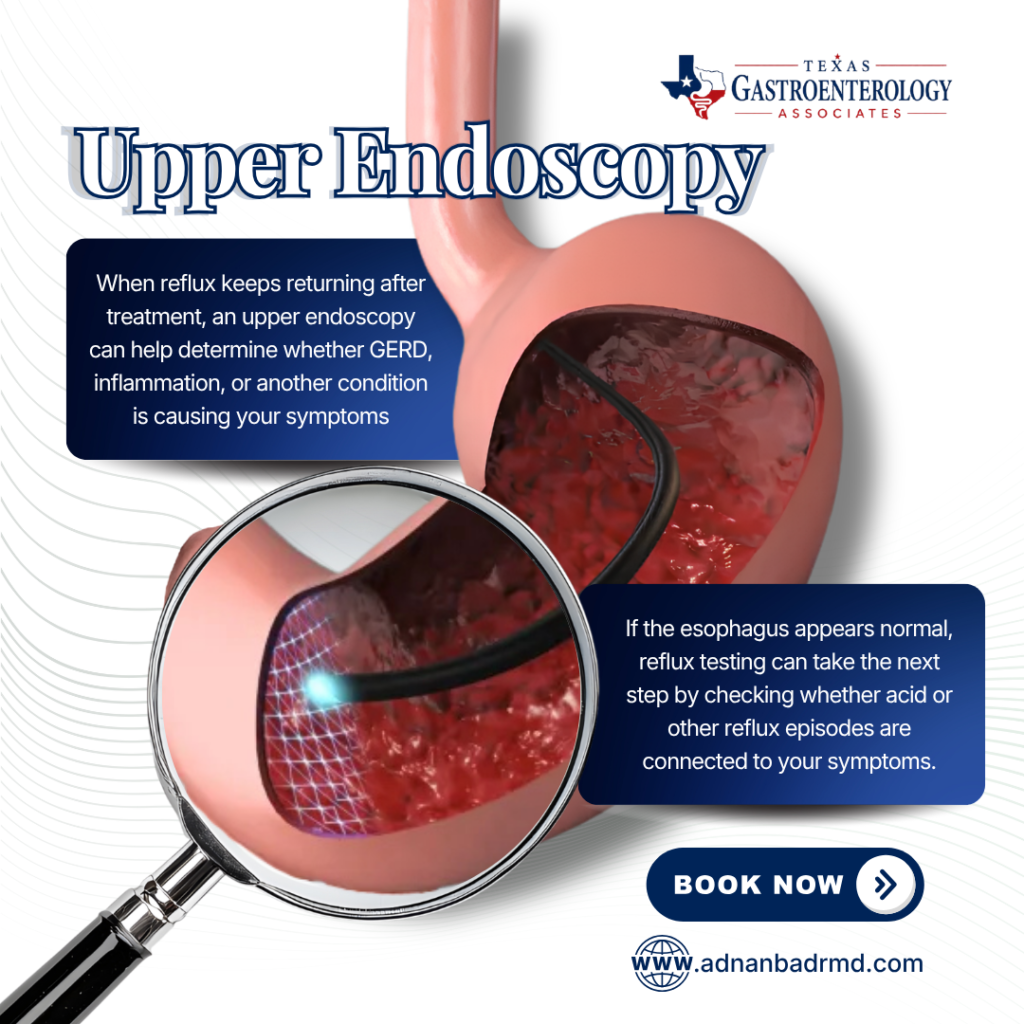
It is crucial to understand that having a normal EGD doesn’t mean the symptoms are imaginary or reflux cannot take place. Even when the esophagus looks normal and GERD is not confirmed, reflux testing can be conducted in order to find out whether there’s a correlation between acid or other reflux episodes and the symptoms.
When Acid Reflux Needs More Than Antacids or Daily Medication
While antacids may provide short-term relief, proton pump inhibitors can be effective for appropriate patients with GERD. However, continuing to increase doses and restarting medications without going back to the diagnostic process can ignore possible problems such as esophageal stricture, eosinophilic esophagitis, ulcer, or something else causing symptoms similar to GERD. The National Institute of Diabetes and Digestive and Kidney Diseases (NIDDK) states that testing might be necessary if symptoms are not alleviated by medications and lifestyle changes, or if complications are suspected.
In GERD evaluation in Frisco/Plano, TX, not only the complaints are important; the duration, time of appearance (day or night), effect of the medications, and presence of alarm symptoms are taken into account before deciding whether an EGD or another test is necessary.
Night time Reflux, Regurgitation, and Throat Symptoms That May Need GERD Evaluation in Frisco/Plano, TX
Reflux that wakes you at night or causes sour fluid to reach the mouth can be particularly disruptive. However, throat clearing, chronic cough, hoarseness, or a sensation of something in the throat should not automatically be labeled reflux. ACG guidelines caution that upper endoscopy alone should not be used to establish reflux as the cause of asthma, chronic cough, or laryngopharyngeal symptoms.
This is where the diagnostic process matters. If typical heartburn and regurgitation occur alongside throat symptoms, the physician may first address the typical GERD component and then consider reflux monitoring or other evaluation if the symptoms persist.
Alarm Symptoms That Should Be Checked Before Assuming It Is Only Acid Reflux
The symptoms of dysphagia are not to be mistaken for heartburn. Symptoms such as difficulty swallowing, feeling food stuck, unexplained weight loss, blood in the vomit or stool, vomiting, and anemia will appear together with reflux issues but can also be associated with narrowing of the esophagus, ulcers, and inflammation of the upper gastrointestinal tract. According to the guidelines by ACG, the first test to run for dysphagia will be endoscopy.
Knowing the difference between simple discomfort and complicated swallowing is very important. If solid food starts feeling stuck in the chest, then the gastroenterologist may perform an EGD in Frisco/Plano, TX, which allows examining the esophagus directly and conducting necessary procedures during the endoscopy.
EGD in Frisco/Plano, TX: How Upper Endoscopy Helps Evaluate Persistent GERD Symptoms
An EGD is a procedure where a thin, flexible camera is used to examine the interior lining of the gastrointestinal tract. This procedure allows a doctor to check for esophagitis, ulcers, irregular tissues, and narrowing in the gastrointestinal tract of the patient, among other clinical changes. Tissue samples can also be collected through the device where necessary.
Dr. Badr describes upper gastrointestinal endoscopy as a minimally invasive type of examination whereby it’s possible to learn about GERD, ulcers, Barrett’s esophagus, celiac disease, and ambiguous abdominal pains. Due to this, the EGD process assists not only in establishing the presence of reflux but also in understanding whether other conditions of the upper digestive tract could have led to the observed symptoms.
Barrett’s Esophagus Evaluation for Patients With Long-Term GERD
Barrett’s esophagus is the medical condition wherein the lining of the lower esophagus changes often due to long-standing GERD. Barrett’s esophagus is a significant condition in that it is known to be a precursor to esophageal adenocarcinoma, although not all patients with GERD will develop Barrett’s esophagus.
There’s no recommendation for screening every individual suffering from heartburn. Notably, the risk factors such as chronic GERD, gender, age, obesity, smoking, and family history may be considered when deciding whether screening is appropriate. In the case Barrett’s is suspected, it is essential that the diagnosis is made through both the endoscopic examination and biopsy rather than appearance.
Why Biopsies May Be Taken During an Upper Endoscopy in Frisco/Plano, TX
During Upper Endoscopy in Frisco/Plano, TX, small tissue samples may be collected when the gastroenterologist needs more information about inflammation, Barrett’s esophagus, or another upper-GI condition.
Although a camera can detect indicators of disease in tissue, it usually cannot identify all the subtle differences at the cellular level. EGD allows small pieces of tissue to be taken without the patient being aware of the biopsy, which is then studied by pathologists.
Biopsies are often performed when there is a suspicion of Barrett’s esophagus or some other conditions mimicking reflux disease. In other words, a biopsy is not necessarily an indicator that cancer is present; it may just be the simplest way of getting accurate information about what’s happening at the cellular level.
Upper Endoscopy in Frisco/Plano, TX: Preparation, Sedation, and Recovery
To prepare for endoscopy, patients should fast so that the upper gastrointestinal tract can be examined safely and clearly. People also need to inform medical workers about any medicines taken before the procedure. It is necessary to mention prescription medication, blood thinners, diabetes medications, food supplements, and related diseases since some medicines require treatment following EGD.
Patients frequently undergo sedation, and many sleep throughout the procedure. Normally, the exam takes 10 to 20 minutes, while the recovery process requires more time as medications must not be distributed from the body. Patients receiving sedation should arrange transportation home and should not drive afterward.
GERD Evaluation and Upper Endoscopy With Dr. Adnan S. Badr in Frisco/Plano, TX
Dr. Adnan S. Badr is a board-certified and fellowship-trained gastroenterologist who specializes in diagnosing and treating GERD and other digestive disorders. Some of the services he provides include upper gastrointestinal endoscopy. He also has published research articles in gastrointestinal diseases such as Barrett’s esophagus, H. pylori infection, and esophageal diseases.
The underlying issue with patients suffering from persistent reflux is not just whether medication could again provide relief. The process of determining whether upper endoscopy in Frisco/Plano, TX, or another diagnostic test is appropriate must take into account symptom patterns, previous treatments, as well as serious symptoms and the possible disorders that may arise in the future.
SYMPTOMS
When Persistent Symptoms May Lead to an Upper Endoscopy in Frisco/Plano, TX
Not every episode of indigestion or heartburn requires an EGD. Dr. Badr considers the pattern of your symptoms, how long they have been present, previous treatment, medical history, laboratory results, and any warning signs before recommending the procedure.
An upper endoscopy may be considered when you have:
- Heartburn or acid reflux that continues despite treatment
- Pain or difficulty when swallowing
- Food that feels stuck in the throat or chest
- Persistent or recurring upper abdominal pain
- Ongoing nausea or repeated vomiting
- Unexplained weight loss or loss of appetite
- Iron-deficiency anemia without a known cause
- Vomiting that contains blood or resembles coffee grounds
- Black or tarry bowel movements
- An abnormality found through imaging or laboratory testing
The reason for performing an EGD is different for each patient. One person may need the procedure to investigate swallowing difficulty, while another may need it to look for a possible source of blood loss.
The goal is not simply to perform a test. It is to answer a specific medical question and use the findings to guide the next step in your care.
What Dr. Badr Can Examine During an EGD in Frisco/Plano, TX
During an EGD, Dr. Badr examines three main areas of the upper digestive tract.
The esophagus is the tube that moves food from your mouth to your stomach. It may be examined for inflammation, narrowing, tissue changes, or other conditions that can affect swallowing.
The stomach can be checked for irritation, ulcers, bleeding, abnormal growths, or changes in its lining.
The duodenum, which is the first section of the small intestine, may show signs of ulcers, inflammation, bleeding, or conditions such as celiac disease.
An upper endoscopy does not examine the colon. The colon is evaluated through a different procedure called a colonoscopy.
CONDITIONS
Conditions an Upper Endoscopy May Help Identify
An EGD can provide important information when symptoms point toward a problem in the upper digestive tract. Depending on the reason for the procedure, Dr. Badr may look for signs of:
- Esophagitis
- Complications related to GERD
- Barrett’s esophagus
- Esophageal strictures or narrowing
- Eosinophilic esophagitis
- Hiatal hernia
- Gastritis
- Peptic ulcers
- Helicobacter pylori-related disease
- Celiac disease
- Upper gastrointestinal bleeding
- Abnormal growths or suspicious tissue
- Certain causes of painful or difficult swallowing
The visual findings are only one part of the evaluation. Some conditions require biopsies, blood tests, imaging, acid testing, or esophageal motility testing before a diagnosis can be confirmed.
For example, a patient may have acid reflux symptoms even when the lining of the esophagus looks normal. A person with swallowing difficulty may also need testing that measures how the esophagus moves food toward the stomach.
Dr. Badr uses the EGD results together with the patient’s symptoms and medical history rather than treating the procedure as a stand-alone answer.
Why a Normal Scan May Not Replace an EGD
Patients sometimes wonder why they need an endoscopy after a CT scan, ultrasound, or another imaging test did not show a clear problem.
These tests provide different types of information.
A CT scan or ultrasound can show organs and structures outside the digestive tract, but they may not reveal subtle changes on the inner lining of the esophagus, stomach, or duodenum. An EGD allows Dr. Badr to inspect that lining directly and collect tissue when necessary.
An upper GI series is also different from an upper endoscopy in Frisco/Plano, TX. It uses X-rays and a barium liquid to show the shape and movement of parts of the upper digestive tract. It does not provide the same direct view or allow a biopsy to be taken.
One test is not automatically better than another. The correct choice depends on your symptoms and the question Dr. Badr is trying to answer.
What a Biopsy During Upper Endoscopy Can Show
The word “biopsy” can sound alarming, but taking a biopsy does not automatically mean cancer is suspected.
A biopsy is a very small tissue sample collected through the endoscope. Patients generally do not feel the tissue being taken. The sample is sent to a laboratory and examined under a microscope.
Biopsies may be collected to evaluate:
- Inflammation in the esophagus or stomach
- H. pylori infection
- Celiac disease
- Eosinophilic esophagitis
- Barrett’s esophagus
- Unexplained tissue changes
- An area that looks different from the surrounding lining
Some conditions cannot be confirmed from appearance alone. The lining may look relatively normal while microscopic changes are present. This is why Dr. Badr may take samples even when no obvious growth or ulcer is seen.
Biopsies are taken for many medical reasons, including situations where cancer is not suspected.
Dr. Badr may discuss the visible findings after the procedure. Biopsy results take additional time because the samples must be reviewed by a pathology laboratory.
An EGD May Diagnose and Treat During the Same Procedure
Upper endoscopy is often performed to find the cause of symptoms, but certain problems can also be treated through the endoscope.
Depending on the reason for your EGD and what Dr. Badr finds, the procedure may allow him to:
- Collect tissue samples
- Treat certain areas of bleeding
- Dilate an appropriate narrowing in the esophagus
- Remove a foreign object
- Remove selected abnormal tissue
- Place clips or other devices when medically necessary
These steps are not performed during every EGD. Some treatments need to be planned before the procedure, while others may be performed when an unexpected finding requires attention.
What can safely be completed depends on the type and location of the problem, your health history, and the purpose for which the procedure was scheduled.
Preparing for an Upper Endoscopy in Frisco/Plano, TX
Your stomach needs to be empty so Dr. Badr can clearly examine the upper digestive tract and reduce the risk of food or liquid entering the lungs during the procedure.
You will receive specific instructions explaining when to stop eating and drinking. Follow the instructions provided by the office or procedure center, even when they differ from general information you have read online.
Before your appointment, tell the care team about:
- Prescription and nonprescription medications
- Blood thinners
- Diabetes medications
- Weight-loss medications
- Vitamins and supplements
- Medication or latex allergies
- Heart or lung conditions
- Sleep apnea
- Pregnancy or possible pregnancy
- Previous problems with sedation or anesthesia
Do not stop an important medication without medical guidance. Dr. Badr or the procedure team will explain whether any medication needs to be adjusted.
Because sedation is commonly used, you will also need to arrange for a responsible adult to drive you home. A taxi or rideshare service may not meet the facility’s discharge requirements unless another adult accompanies you.
What Happens During the EGD Procedure?
Before the procedure begins, the care team will review your health information, confirm the reason for the EGD, and answer any last-minute questions. Monitoring equipment will be used to follow your breathing, heart rate, blood pressure, and oxygen level.
You will usually lie on your side. A small mouth guard may be placed to protect your teeth and the endoscope.
Once sedation has been administered, Dr. Badr carefully guides the flexible endoscope through the mouth and into the esophagus, stomach, and duodenum. The scope passes through the digestive tract rather than the airway, so it does not prevent you from breathing.
Dr. Badr examines the lining, records relevant images, and performs biopsies or treatment when needed. The endoscope is then removed, and you are taken to a recovery area for monitoring.
Sedation plans can differ based on the patient, the procedure setting, and the complexity of the examination.
Recovery, Eating, Driving, and Returning to Work
You will remain in recovery until the care team determines that you are ready to leave. It is common to feel tired or groggy for a period of time after sedation.
Some patients notice a mild sore throat, temporary bloating, or gas. These effects usually improve, but your personal recovery may depend on whether biopsies, dilation, bleeding treatment, or another step was completed.
Your discharge instructions will explain:
- When you can begin drinking liquids
- When you can return to regular food
- When to restart medications
- What activity restrictions to follow
- When you may return to work
- How and when results will be communicated
You should not drive, operate machinery, make important legal or financial decisions, or drink alcohol for the period stated in your discharge instructions. Even when you feel awake, sedation may continue to affect coordination and judgment.
Visible findings may be discussed before you leave, but you may not remember every detail because of the sedation. Written instructions and follow-up communication can help you understand what was found.
Which Symptoms After an Upper Endoscopy Need Prompt Attention?
Serious complications are uncommon, but no procedure is completely without risk.
Follow your discharge instructions and contact the care team or seek urgent medical attention if you experience:
- Severe or worsening chest or abdominal pain
- Difficulty breathing
- Fever
- Repeated vomiting
- Vomiting blood
- Black or tarry stool
- Heavy bleeding
- Increasing difficulty swallowing
- Dizziness, fainting, or unusual weakness
A mild sore throat or temporary bloating may occur. Symptoms that are severe, continue to worsen, or feel different from what you were told to expect should not be ignored.
Understanding Your EGD Results and What Happens Next
The next step depends on what the upper endoscopy shows.
After an upper endoscopy in Frisco/Plano, TX, Dr. Badr will explain the visible findings and whether biopsies, medication changes, or additional testing may be needed.
Your results may reveal inflammation, an ulcer, narrowing, a bleeding source, a hiatal hernia, or an area that requires biopsy. Dr. Badr may recommend medication, dietary changes, follow-up testing, additional treatment, or monitoring based on those findings.
Sometimes an EGD does not show a visible abnormality. That does not mean the symptoms are imaginary or unimportant.
Some digestive problems involve how the esophagus moves, how the stomach empties, how much acid reaches the esophagus, or how the nerves of the digestive tract respond. These concerns may require tests such as esophageal manometry, pH monitoring, or a gastric emptying study.
The purpose of the EGD is to narrow down the possible causes and help determine the most appropriate direction—not to force every patient into the same treatment plan.
ANSWERS TO COMMON QUESTIONS
Frequently Asked Questions
The interval will differ for different patients. Continuous symptoms even after a course of PPI trial, symptoms recur after stopping treatment, or alarming symptoms such as dysphagia, bleeding, anemia, or weight loss indicate that endoscopy is necessary.
It will show various forms of esophageal damage, but a normal EGD will not confirm that throat symptoms are due to reflux or not. In cases of indeterminate diagnosis, reflux monitoring can be useful in obtaining information that cannot be obtained through endoscopy.
The feeling of food being stuck may indicate the presence of dysphagia, which can be caused by narrowing, inflammation, or other conditions of the esophagus. Dysphagia is an alarming symptom; therefore, EGD may be suggested to visualize the esophagus directly.
Yes, severity of heartburn doesn’t indicate the existence of Barrett’s. Decisions concerning screening are based on the overall pattern of GERD and risk factors involved.
A hiatal hernia can be found using an EGD when examining the upper digestive tract, but advanced imaging is needed if necessary.
Biopsy specimens are microscopically examined and are necessary to analyze for cell disease. Some diseases like Barrett's esophagus cannot have a reliable appearance only based on the appearance of the digestive lining.
Yes. Many patients with reflux symptoms don’t display any esophageal injury. If EGD is normal but GERD has not been determined, reflux monitoring can reveal whether reflux is the source of the symptoms.
Schedule an Upper Endoscopy Consultation With Dr. Adnan S. Badr
If you are considering Upper Endoscopy in Frisco/Plano, TX, schedule a consultation with Dr. Adnan S. Badr to discuss persistent reflux, swallowing difficulty, unexplained upper abdominal pain, nausea, anemia, or other upper-digestive concerns.
Your evaluation may include a discussion of your symptoms, previous treatments, medications, laboratory results, imaging, and other medical records. If an EGD is recommended, you will receive instructions based on your health history and the reason for the procedure.
4500 Hillcrest Rd, Ste 185
Frisco, TX 75035
Phone: (972) 514-3530
Call the office to schedule a gastroenterology consultation or discuss an existing upper endoscopy referral.
Frisco
4500 Hillcrest Rd, Ste 185, Frisco, TX 75035
Plano
5800 Communications Parkway, Plano, TX 75093
Phone
(972) 514-3530 · Fax (972) 514-3531
Hours
Mon–Thu 8:00 AM–4:30 PM · Fri 8:00 AM–4:00 PM